NGC 7320
Galaxy in the constellation Pegasus
From Wikipedia, the free encyclopedia
NGC 7320 is an unbarred spiral galaxy located approximately 39 million light-years away in the constellation Pegasus. It was discovered on 27 September 1873 by the French astronomer Édouard Stephan.[5]

| NGC 7320 | |
|---|---|
NGC 7320 imaged by the Hubble Space Telescope | |
| Observation data (J2000.0 epoch) | |
| Constellation | Pegasus |
| Right ascension | 22h 36m 03.4s[1] |
| Declination | +33° 56′ 53″[1] |
| Redshift | 786 ± 20 km/s[1] |
| Distance | 39 million ly (12 Mpc)[2] |
| Apparent magnitude (V) | +13.2[1] |
| Apparent magnitude (B) | 13.8[3] |
| Absolute magnitude (V) | −17.8[3] |
| Absolute magnitude (B) | −16.6[3] |
| magnitude (J) | 11.2[3] |
| magnitude (H) | 9.8[4] |
| magnitude (K) | 9.5[4] |
| Characteristics | |
| Type | SA(s)d[1] |
| Size | 9.56 kiloparsecs (31,170 light-years) (diameter; 25.0 mag/arcsec2 B-band isophote)[1] |
| Apparent size (V) | 2.2′ × 1.2′[1] |
| Notable features | Foreground projection on Stephan's Quintet |
| Other designations | |
| UGC 12101, PGC 69270, Arp 319, HCG 092A[1] | |
While visually grouped as the brightest apparent member of Stephan's Quintet (Hickson Compact Group 92), NGC 7320 is not gravitationally associated with the core interacting cluster. It is instead a foreground projection positioned along the same line of sight from Earth, lying at roughly one-seventh the distance of the background group.[6]
Observational history
Historically, the spatial location of NGC 7320 was a central point of contention in the mid-20th century cosmic distance scale debate. Spectroscopic observations obtained by Geoffrey and Margaret Burbidge in 1961 revealed a discordant heliocentric redshift of 786 km/s for NGC 7320, contrasted against the ~6,600 km/s velocities of the surrounding members.[7] Anomalous redshift proponents argued this indicated physical proximity with non-cosmological redshift factors. However, high-resolution imaging from the Hubble Space Telescope successfully resolved individual population I stars and localized interstellar dust within NGC 7320—confirming its proximity as a foreground silhouette.[6]
Group membership
Based on its distance and spatial velocity, NGC 7320 is classified as a physical member of the nearby NGC 7331 Group (Deer Lick Group), centered around the isolated unbarred spiral galaxy NGC 7331.[8]
Physical characteristics
NGC 7320 is classified morphologically as an SA(s)d intermediate-to-late type spiral galaxy under the De Vaucouleurs profile. Unlike the structurally stripped background members of Hickson 92, NGC 7320 maintains an unperturbed interstellar medium. High-resolution infrared imaging from the James Webb Space Telescope's Mid-Infrared Instrument (MIRI) demonstrates extensive, active H II regions embedded along its outer spiral filaments, tracing massive ongoing stellar assembly cycles driven by its native cold gas reservoirs.[9]
Image gallery
 NGC 7320 imaged by the James Webb Space Telescope.
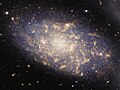 NGC 7320, taken by the James Webb Space Telescope

.jpg)

