Nagore Durgha, Singapore
From Wikipedia, the free encyclopedia
| Nagore Durgha நாகூர் தர்கா | |
|---|---|
_Sufi_Shrine_(2025)_-_img_04.jpg) | |
| Religion | |
| Affiliation | Sunni Islam (Sufi) |
| Location | |
| Location | 140 Telok Ayer Street, Singapore 068604 |
| Country | Singapore |
.svg)  Location in Singapore | |
| Coordinates | 1°16′53″N 103°50′52″E / 1.2814523°N 103.8477778°E |
| Architecture | |
| Type | Shrine and mosque |
| Style | Indo-Saracenic architecture |
| Established | 1827 |
| Completed | 1830 2011 (As a museum) |
| Minaret | 4 |
| Designated as NHL | |
| Designated | 19 November 1974 |
| Reference no. | 9 |
The Nagore Durgha (Tamil: நாகூர் தர்கா; Chinese: 纳宫神社, romanized: Na Gong Shen She), alternatively known as the Nagore Dargâh, is an Indian Muslim heritage centre located along Telok Ayer Street in Chinatown, Singapore. Formerly a 19th-century shrine and memorial dedicated to Nagore Shahul Hamid, it now serves as a museum to commemorate the contributions of Indian Muslims in Singapore.[1][2][3]

A shrine dedicated to commemorate a visit of the 16th-century Muslim saint Nagore Shahul Hamid was built between 1828 to 1830 by the Chulias, a group of South Indian immigrants who worked in the Chinatown district.[4][5][6] The land on which the shrine stood on was originally granted to an Indian Muslim merchant named Kaderpillai, on condition that the land not be used for a building made of wood or attap.[4][7] The primary materials in the construction of the shrine, including limestone, concrete and steel, were imported from overseas by two brothers, Mohammed and Haja Mohideen.

The original trustee of the shrine's endowment was Kaderpillai, with his ownership of the shrine tied to a lease for a period of ninety-nine years since 1827.[8] After Kaderpillai had died, five new trustees were appointed on 15 June 1893 to manage the shrine.[8] By 1910, the land's lease was renewed and in November of that year, another group of new trustees was appointed from the committees of the other two mosques in Chinatown, Masjid Al-Abrar and Masjid Jamae Chulia.[8] After 1965, the shrine went under the management of the National Heritage Board as well as Singapore's Islamic council, the Majlis Ugama Islam Singapura (MUIS). It was later gazetted as a national heritage monument on 19 November 1974.[4][5][6]
Between 1982 to 1994, the shrine was used as a mosque.[7] The shrine was boarded up in the 1990s, starting from late 1994 due to deterioration.[9][10][11] In the 2000s, the shrine was closed to the public due as part of safety measures due to the structural issues.[9][11][12] Major renovation works to restore the shrine were conducted in 2007, although the shrine still remained closed to the public. Finally, in December 2010, the MUIS announced that the shrine would be converted into a museum to commemorate the contributions of Indian Muslims in Singapore, featuring exhibits including displays and artefacts about Indian Muslims.[13][14][15] Now functioning as an Indian Muslim heritage centre, the Nagore Durgha was officially reopened on 29 May 2011 by the then-President of Singapore, S.R. Nathan.[9][16]
The former shrine underwent extensive upgrading works in 2013 as well as complete repainting of the whole building. The upgrading was completed in late 2014 and the museum reopened its doors on 6 January 2015, introducing a brand new multimedia exhibit featuring the stories of pioneers of the Indian Muslim community.[5][17][18] Currently, the building does not function as a shrine or mosque anymore.[19]
Architecture
The Nagore Durgha is built in the style of Indo-Saracenic architecture although it has elements from other forms of European architecture such as the Corinthian capitals that support the entrance doorway.[20][21] Four minarets, each with fourteen layers and topped by an onion dome, flank each of the four corners of the main building.[20][21] Within the building, past the entrance, are galleries and exhibits on either side of the main hall as well as many corridors that contain exhibits themselves.[5][21]
Two keramats (enshrined graves) once existed in a sepulchre in the main hall of the shrine.[20] These keramats were mainly symbolic shrines that did not contain any human remains and were removed from the building after its conversion into a museum.[19][22] A restaurant that had been blessed by the descendants of Nagore Shahul Hamid also existed within the museum, but was later removed in 2012.[23]
Gallery
 Main facade of the Nagore Durgha, with three niches and the entrance doorway in the center.
 The Nagore Durgha after the most recent renovations.
 A close-up view of one of the minarets of the building.
 Rear view of the building, with cars parked along Boon Tat Street.
 Panoramic view of the entrance chamber of the building; the entrance to the main hall can be seen ahead.
.jpg)
.jpg)
.jpg)
.jpg)

Historic photographs
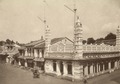 An aerial view of the Nagore Durgha shrine in 1910.
 Nagore Durgha as seen in the 1930s. An unnamed mosque, of similar architectural construction, can be seen in the foreground opposite the shrine.
 An early 19th century photograph of Telok Ayer Street. The shrine is in the right side of the picture, with the unnamed mosque visible in the left.
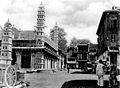 A photograph of Boon Tat Street in the late 19th century. The shrine can be seen in the background, as well as the minaret of the unknown mosque.


Transportation
The Nagore Durgha is directly accessible from Exit A of the Telok Ayer MRT station on the Downtown Line.[24]

