Nanking Provisional Government cabinet
From Wikipedia, the free encyclopedia
Yuan Shikai (10 March – 1 April 1912, as provisional President)
Nanking Provisional Government cabinet | |
|---|---|
.svg) 1st Cabinet of the Provisional Government of the Republic of China | |
| 3 January 1912 – 1 April 1912 | |
.jpg) The first cabinet meeting of the Nanking Provisional Government cabinet, 21 January 1912 | |
| Date formed | 3 January 1912 |
| Date dissolved | 1 April 1912 |
| People and organisations | |
| Head of state | Sun Yat-sen (1 January – 1 April 1912, as provisional President)
Yuan Shikai (10 March – 1 April 1912, as provisional President) |
| Head of government | Sun Yat-sen (1 January – 1 April 1912) |
| Deputy head of government | Li Yuanhong (as provisional Vice-President) |
| No. of ministers | 9 ministers and 9 deputy ministers |
| Total no. of members | 20 (including the provisional President and provisional Vice President) |
| Member parties |
|
| Status in legislature | Tongmenghui-led provisional coalition government |
| History | |
| Election | 1911 Chinese provisional presidential election |
| Legislature term | Provisional Government of the Republic of China |
| Predecessor | Cabinet of Yuan Shikai (Qing Dynasty) |
| Successor | First Tang Shaoyi cabinet |
The Nanking Provisional Government cabinet (Chinese: 南京臨時政府內閣; pinyin: Nánjīng línshí zhèngfǔ nèigé), also known as the Sun Yat-sen cabinet, was a temporary cabinet of the republican era of China. The first cabinet assembled following the formation of the Provisional Government on 1 January 1912; it was formed on 3 January 1912 and dissolved on 1 April the same year. It was the first and only cabinet led by Sun Yat-sen, the first provisional President of the Republic of China.

| Nanking Provisional Government cabinet | |||||||
|---|---|---|---|---|---|---|---|
| Traditional Chinese | 南京臨時政府內閣 | ||||||
| Simplified Chinese | 南京临时政府内阁 | ||||||
| |||||||
On 1 January 1912, Sun Yat-sen, the leader of the Tongmenghui, was inaugurated as the first provisional President of the newly proclaimed Republic of China following the conclusion of the Xinhai Revolution. Two days later, representatives of all provincial leaders approved a list of ministerial heads to be appointed in the first cabinet.[1] The absence of several cabinet members in Nanking (presently Nanjing) delayed the first cabinet meeting, which wasn't held until 21 January. The meeting was hosted by Sun.[2]
On 13 March, Tang Shaoyi, the first Premier of the Republic of China, began the formation of a new cabinet at Peking (presently Beijing). On 1 April, Sun Yat-sen resigned from his position as provisional President. In his resignation letter, written two days after his resignation, Sun stated, "Today (3 April 1912), Premier Tang went southbound and visited me, all ministerial positions in the cabinet were confirmed, and the news has been reported to me at Nanking on 1 April. I hereby resign today (as President)......all cabinet ministers will remain and continue their duties until all new replacements are appointed." All ministers and their respective deputies in the cabinet were subsequently relieved of their duties once the new cabinet was formally appointed.[1]
The Nanking Provisional Government was a presidential government under the leadership of a president. This system was abolished following Yuan Shikai's ascension to power whereby a parliamentary government was introduced in the form of the National Assembly led by a Premier. The changes were made to limit Yuan's presidential powers, making him a figurehead in the government.[1]
Ministries
Prior to the formation of the Provisional Government in 1912, the revolutionaries had notified provincial representatives to form local general staffs to unify the military situation during the revolutions in 1911. However, when Sun Yat-sen became provisional President, none of the provincial representatives had arrived to meet him in time, thus when the General Staffs Office was founded on 6 February 1912, Sun appointed Huang Xing as its first chief of staff.[1]
On 3 January 1912, the list of ministers of the first cabinet was approved by all provincial representatives in the new Republic.[1] On 5 January, an inauguration ceremony of all cabinet ministers was hosted by provisional President Sun Yat-sen. Each ministries were founded on different dates after the inauguration of their respective ministers. Their date of founding is listed as such:[3]
| Date of founding of each ministries of the Provisional Government | ||
| Ministries upon founding | Date of founding (in ascending order) |
Headquarter(s) |
|---|---|---|
| Ministry of the Army 陸軍部 |
9 January 1912 | - |
| Ministry of Foreign Affairs 外交部 |
11 January 1912 | Presidential Palace, Nanking (11 January–2 March 1912) Drum Tower of Nanjing, Nanking (2 March 1912 onwards) |
| Ministry of Justice 司法部 |
12 January 1912 | - |
| Presidential Office 總統府 |
14 January 1912 | Commission House, Presidential Palace, Nanking. |
| Bureau of Legislative Affairs 法制局 |
15 January 1912 | - |
| Ministry of Finance 財政部 |
17 January 1912 | - |
| Ministry of Internal Affairs 内政部 |
17 January 1912 | Jiangnan Municipal Office, Nanking. |
| Ministry of the Navy 海軍部 |
17 January 1912 | Jiangnan Navy Academy, Nanking. |
| Ministry of Education 教育部 |
19 January 1912 | - |
| Ministry of Trade 实业部 |
23 January 1912 | - |
| Ministry of Transportation 交通部 |
23 January 1912 | - |
| General staffs office 參謀本部 |
6 February 1912 | - |
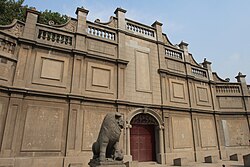 The Jiangnan Navy Academy, the former headquarters of the Ministry of the Navy.
 The Commission House, part of the Presidential Palace at Nanking (presently Nanjing), housed the first Presidential Office of the Provisional Government.
 The Drum Tower of Nanjing housed the offices of the Ministry of Foreign Affairs after 2 March 1912.


.jpg)
.jpg)

.jpg)
.jpg)
.jpg)
.jpg)
.jpg)
.jpg)
.jpg)
.jpg)
.jpg)
.jpg)
.jpg)
.jpg)
.jpg)
.jpg)
.jpg)
.jpg)
.jpg)
.jpg)
.jpg)