
National costumes of Poland
From Wikipedia, the free encyclopedia
National costumes of Poland (Polish: stroje ludowe) vary by region. They are typically not worn in daily life but at folk festivals, folk weddings, religious holidays, harvest festivals and other special occasions.[1] The costumes may reflect region and sometimes social or marital status.[1]


Poland's inhabitants live in the following historic regions of the country: Greater Poland, Lesser Poland, Mazovia, Pomerania, Warmia, Masuria, Podlachia, Kuyavia and Silesia.
Lesser Poland / Małopolska
- Kraków region:[2] The woman's costume includes a white blouse, a vest that is embroidered and beaded on front and back, a floral full skirt, an apron, a red coral bead necklace, and lace-up boots. Unmarried women and girls may wear a flower wreath with ribbons while married women wear a white kerchief on their head. The men wear a blue waistcoat with embroidery and tassels, striped trousers, a krakuska cap ornamented with ribbons and peacock feathers and metal rings attached to the belt.
- Lachy Sądeckie live in southern Lesser Poland, especially in Nowy Sącz County and Kotlina Sądecka.
 Western Kraków region
 Eastern Kraków region
 Kraków region
 Lachy Sądeckie men's costume
 Lachy Sądeckie, including married woman's costume
 Lachy Sądeckie, including unmarried woman's costume
 Lesser Poland


_(cropped).jpg)
Gorals / Górale
Gorals live in southern Poland along the Carpathian Mountains, in Podhale of the Tatra Mountains and parts of the Beskids. Their costumes vary depending on the region.[3]

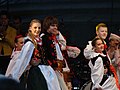
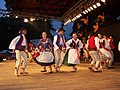 Żywiec
 Podhale
 Zakopane (1938)
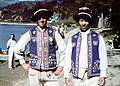 Szczawnica (1939)
 Gorals from Cieszyn Silesia
 Tatra Gorals in 1877
 Żywiec Gorals in 2016
 Żywiec Gorals in traditional costume
 Podhale Gorals in traditional costume


Subcarpathian region / Podkarpacie
 Pogórzanie
 Pogórzanie
 Rzeszowiacy
 Pogórzanie
 Sanok (Kamraty)
 Lasowiacy (Mazurians)
 Rymanów (Pogórzanie)
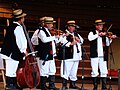 Liszna (Sanok)
 Lemkos from Przemyśl


,_2010_Bukowsko.JPG)


_..jpg)

Lublin region
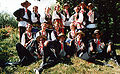 Lublin region
 Lublin
 Biłgoraj


Silesia / Śląsk
- Bytom / Piekary Śląskie in Upper Silesia[7]
- Cieszyn Silesia, see
- Lower Silesia
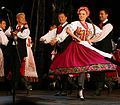

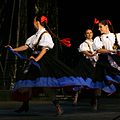
 Lower Silesia
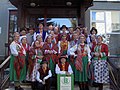 Wilamowice, Vilamovians


Pomerania / Pomorze, Kujawy, Warmia


Masovia and central Poland


Podlaskie / Podlasie
 Podlasie


Greater Poland / Wielkopolska


Nobility
The szlachta were Polish nobles and had their own attire which included the kontusz, pas kontuszowy, and a crimson żupan.[20]
 Nobility
 Bractwo Kurkowe (Kraków)
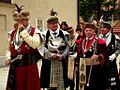 Bractwo Kurkowe (Kraków)
 17th century
 Żywiec
 King Stanisław I in a Cracovian costume


.jpg)


