A single element  of a random vector
  is neutral if the relative proportions of all the other elements are independent of .
Formally, consider the vector of random variables

where

The values are interpreted as lengths whose sum is unity. In a variety of contexts, it is often desirable to eliminate a proportion, say  , and consider the distribution of the remaining intervals within the remaining length. The first element of
  , viz is defined as neutral if is statistically independent of the vector

Variable  is neutral if
 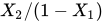 is independent of the remaining interval: that is, being independent of

Thus , viewed as the first element of  , is neutral.
In general, variable  is neutral if
  is independent of

A vector for which each element is neutral is completely neutral.
If  is drawn from a Dirichlet distribution, then is completely neutral. In 1980, James and Mosimann[2] showed that the Dirichlet distribution is characterised by neutrality.