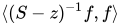
Nevanlinna function
From Wikipedia, the free encyclopedia
In mathematics, in the field of complex analysis, a Nevanlinna function is a complex function which is an analytic function on the open upper half-plane and has a non-negative imaginary part. A Nevanlinna function maps the upper half-plane to itself or a real constant,[1] but is not necessarily injective or surjective. Functions with this property are sometimes also known as Herglotz, Pick or R functions.

Every Nevanlinna function N admits a representation

where C is a real constant, D is a non-negative constant, is the upper half-plane, and μ is a Borel measure on ℝ satisfying the growth condition

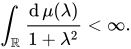
Conversely, every function of this form turns out to be a Nevanlinna function. The constants in this representation are related to the function N via

and the Borel measure μ can be recovered from N by employing the Stieltjes inversion formula (related to the inversion formula for the Stieltjes transformation):
![{\displaystyle \mu {\big (}(\lambda _{1},\lambda _{2}]{\big )}=\lim _{\delta \rightarrow 0}\lim _{\varepsilon \rightarrow 0}{\frac {1}{\pi }}\int _{\lambda _{1}+\delta }^{\lambda _{2}+\delta }\Im {\big (}N(\lambda +i\varepsilon ){\big )}\operatorname {d} \lambda .}](https://wikimedia.org/api/rest_v1/media/math/render/svg/8abb87b10488af44e410049f3dd96299c58b4693)
A very similar representation of functions is also called the Poisson representation.[2]