New Melilla
From Wikipedia, the free encyclopedia


From the end of the 19th century, a period of splendor began in Melilla, creating a modern city. Among Spanish cities, Melilla is second only to Barcelona in its representation of modernist art. The city also has the greatest representation of modernism in Africa.[3][4]
More than a thousand historically registered buildings are found in the Historic-Artistic Complex of the City of Melilla, a Bien de Interés Cultural, or cultural property of Spain. The buildings are spread throughout the central expansion and its neighborhoods.
Many of the buildings are the work of a Melilla-based architect from the Barcelona School, Enrique Nieto. Nieto, a follower of the architect Lluis Domènech i Montaner produced an extensive body of modernist work. Nieto's floral modernist buildings are especially noteworthy. Other modernist architects in Melilla were Emilio Alzugaray Goicoechea and Tomás Moreno Lázaro. In the 1930s, Art Deco took hold in Melilla's architecture, and architects such as Francisco Hernanz Martínez and Lorenzo Ros Costa created spectacular buildings in the city's neighbourhoods.[5][6][7][8]
Exterior forts
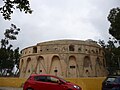 Fuerte de Camellos
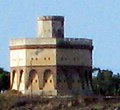 Fortín de Reina Regente
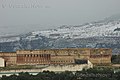 Fuerte de Cabrerizas Altas
 Fuerte de Rostrogordo


_(7085316031).jpg)

Melilla's exterior forts are located at a considerable distance from each other. They were built in the second half of the 19th century in a neo-medieval style, an unusual architectural style for that era in Spain.[9]
They are built with local stone for the walls and bricks for the arches and vaults.[9] These obsolete fortification techniques, incapable of facing modern artillery, were sufficient because the Riffian Kabyle people, the enemy from which they had to defend Melilla, did not have artillery.[citation needed]
Historicisms
In Melilla, historic revival architecture is primarily found in public buildings and places of worship.[citation needed]
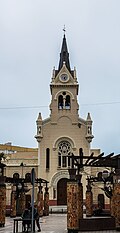 Church of the Sacred Heart, a neo-Romanesque Catholic church
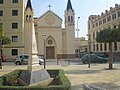 Neogothic Catholic church (rear)
 Neogothic building, formerly the College of Good Counsel
 Regional neocolonial building originally for Gaselec, an electric utility,
 Central Mosque in Mudejar and Arabic styles
 The neo-Arabic Bombillo Fountain
 Neo-Arabic House of Crystals


._Melilla_(España)._Estilo_Historicista.jpg)


Eclecticisms
 Metropol Building
 Grupo de Escuelas Mixtas Alfonso XIII
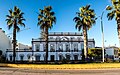 Melilla Port Authority Building
 Estación sanitaria del Puerto de Melilla (Former health station of the Port of Melilla)
 Carmen Balaca's House
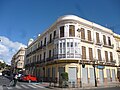 Headquarters of the Civil Society La Constructora
 Polígono Market
 Polígono Market


.jpg)
.jpg)


Eclecticism in Melilla mixes rigid structural elements with richer ornamentation, such as wrought iron and flying cornices.[10] The most notable practitioner of eclecticism in Melilla was Droctoveo Castañón, who primarily built private residences.[10]
Modernism
New Melilla's architecture is defined by modernism, a continuation of the Rococo style, with rich ornamentation, a variety of evocative shapes and varied colors.[11]
Enrique Nieto
Enrique Nieto is credited with introducing modernist architecture to Melilla.[10]
 Former editorial office of El Telegrama del Rif
 Official Chamber of Commerce, Industry and Navigation
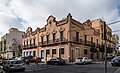 Furniture La Reconquista
 Former Military Commissary
 Former Reconquista Department Store
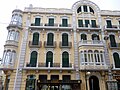 David J. Melul House
 House of Jose Zea and Manuel Alvadalejo
 House of Jose Garcia Alvaro
 House of Juan Montes Hoyo


Emilio Alzugaray
 College of the Brothers of the Christian Schools
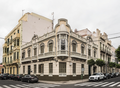 House of Solomon Cohen
 Casa de las Fieras (Melilla) (House of Beasts)
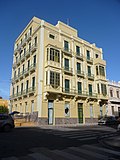 House of Jose Morely
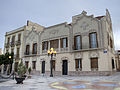 Samuel Salama's Widow's House
.jpg)

.jpg)


Art Deco
 Monumental Cinema Sport

The Art Deco Monumental Cinema Sport, constructed between 1930 and 1932, is the masterpiece of architect Lorenzo Ros y Costa.[12]
Enrique Nieto
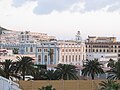 Palace of the Assembly
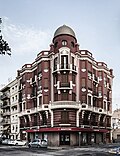 Red Building
 Enrique Nieto's House
 Carcaño's House
 Rafael Rico Albert's House
 Real Market


Francisco Hernanz
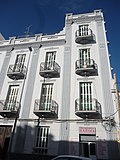 House of Jacinto García Marfil
 House of Luis Raya
 House of Abraham Benatar
 House of Bertila Seoane
 House of Juan Parres Puig

.jpg)
.jpg)
.jpg)

Francisco Hernanz built in an aerodynamic art deco style, with sober lines and almost no decoration.[13]
Rationalism
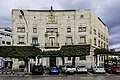 Bank of Spain building
 Post Office Building in Melilla
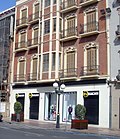 Amram J. Wahnon House
 Cervantes Street, 4


.jpg)

.jpg)


.jpg)
.jpg)


.jpg)


.jpg)


.jpg)
.jpg)
.jpg)


.jpg)


.jpg)
.jpg)


