Nine-point hyperbola
From Wikipedia, the free encyclopedia

In Euclidean geometry with triangle △ABC, the nine-point hyperbola is an instance of the nine-point conic described by American mathematician Maxime Bôcher in 1892. The celebrated nine-point circle is a separate instance of Bôcher's conic:
- Given a triangle △ABC and a point P in its plane, a conic can be drawn through the following nine points:
- the midpoints of the sides of △ABC,
- the midpoints of the lines joining P to the vertices, and
- the points where these last named lines cut the sides of the triangle.
The conic is an ellipse if P lies in the interior of △ABC or in one of the regions of the plane separated from the interior by two sides of the triangle; otherwise, the conic is a hyperbola. Bôcher notes that when P is the orthocenter, one obtains the nine-point circle, and when P is on the circumcircle of △ABC, then the conic is an equilateral hyperbola.
An approach to the nine-point hyperbola using the analytic geometry of split-complex numbers was devised by E. F. Allen in 1941.[1] Writing , j2 = 1, he uses split-complex arithmetic to express a hyperbola as


It is used as the circumconic of triangle Let Then the nine-point conic is


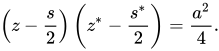
Allen's description of the nine-point hyperbola followed a development of the nine-point circle that Frank Morley and his son published in 1933. They requisitioned the unit circle in the complex plane as the circumcircle of the given triangle.
In 1953 Allen extended his study to a nine-point conic of a triangle inscribed in any central conic.[2]