Removing a node or multiple nodes randomly from a network means that the elimination of a set of nodes happens with a certain probability. The probability of deleting a node can follow any distribution; the most common is to assume a uniform distribution. The effect of the node deletion is highly dependent on the topology of the network, so it affects each empirical network differently.[1]
The effect on the network connectedness is measured with the diameter of the network (the length of the longest shortest path between two nodes).[2] When we remove a fraction f of nodes, the diameter of the network increases monotonically with f. This is because each node has approximately the same degree and thus contributes to the interconnectedness by relatively the same amount.
The effect on a scale-free network is very different from what is experienced with random networks. As f increases, the diameter remains unchanged even on a 5% error level. This robustness comes from the presence of hubs in the network. As long as the hubs are not malfunctioning, the interconnectedness of the network is untouched.
When node deletion is combined with other processes, the topology of the network can change drastically. To illustrate this, consider the BA model. In each step add a new node with m links to the network, and also remove a node with probability r. This leads to different networks depending on m and r.[3]
 , Scale-free Phase: In this phase the network keeps growing, although the growth rate is smaller due to the deletion of nodes. Here the degree distribution remains a power law, with the coefficient
 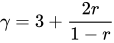 .
. , Exponential Phase: In this case the removal of nodes and the appearance of new ones are equal, so the network has a constant size. The network loses its scale-free property, the degree distribution turns into a stretched exponential.
 , Declining Network: The rate of removal is higher than the growth rate, so the network declines, after finite steps it disappears.
