Non-degenerate two-photon absorption
From Wikipedia, the free encyclopedia

In atomic physics, non-degenerate two-photon absorption (ND-TPA or ND-2PA) [1] or two-color two-photon excitation[2] is a type of two-photon absorption (TPA) where two photons with different energies are (almost) simultaneously absorbed by a molecule, promoting a molecular electronic transition from a lower energy state to a higher energy state. The sum of the energies of the two photons is equal to, or larger than, the total energy of the transition.
The probability of ND-TPA is quantified as the non-degenerate two-photon absorption cross section (ND-TPACS) and is an inherent property of molecules. ND-TPACS has been measured using Z-scan (pump-probe) techniques,[3] which measure the laser intensity decrease due to absorption, and fluorescence-based techniques,[4] which measure the fluorescence generated by the fluorophores upon ND-TPA.
In ND-TPA, by absorbing the first photon, the molecule makes a transition to a virtual state and stays in the virtual state for an extremely short period of time (virtual state lifetime, VSL). If a second photon is absorbed during the VSL, the molecule makes a transition to the excited electronic state, otherwise it will relax back to the ground state. Therefore, the two photons are "almost" simultaneously absorbed in two-photon absorption. Based on the time–energy uncertainty relation, VSL is inversely proportional to the energy difference between the virtual state and the nearest real electronic state (i.e. the ground or a nearby excited state). Therefore, the closer the virtual state to the real state, the longer the VSL and the higher the probability of TPA. This means that in comparison to degenerate TPA, where the virtual state is in the middle of the ground and the excited state, ND-TPA has a larger absorption cross-section. This phenomenon is known as the resonance enhancement and is the main mechanism behind the observed increase in ND-TPACS of semiconductors [5] and fluorophores[6][7] in comparison to their degenerate TPA cross-sections.
ND-TPA has also been explored in two-photon microscopy for decreasing out-of-focus excitation, increasing penetration depth, increasing spatial resolution, and extending the excitation wavelength range.
The following discussion of techniques for quantitatively obtaining important parameters for use in ND-TPA is a summary of concepts discussed in Yang et. al. [8]
Beer's law describes the decay in intensity due to one-photon absorption:
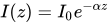
where z is the distance that the photon travels in a sample, I(z) is the light intensity after traveling a distance z in the sample and α is the one-photon absorption coefficient of the sample.
In ND-TPA, two different color photons come together, providing the following adaptation of the previous equation, and using a near-infrared (NIR) and short-wavelength infrared (SWIR) photon for ease of interpretation:

where A is a combined term describing the absorption cross section, collection efficiency, fluorophore concentration and quantum efficiency.
For fluorescence with a non-uniform flux, as exists in ND-TPA, the following equation qualifies:

where K is the product of the quantum yield of the fluorophore, geometry of the imaging system and the fluorophore concentration and is assumed to be independent of the excitation regime, and σ is the absorption cross section. Note that the desynchronization level of the two laser pulses, as shown through the time and spatial delay in ISWIR, affects the overall fluorescence of a given volume within a specimen. Also important to note is that photon beam fluxes can be combined in this fashion, allowing for one photon flux to be increased proportionally to the decrease in flux experienced by another photon due to scattering effects, as in biological tissue.