As an example let us model the wave equation,

The naive finite difference model, which we now call the standard (S) FD model is found by approximating the derivatives with FD approximations. The central second order FD approximation of the first derivative is

Applying the above FD approximation to  , we can derive the FD approximation for
  ,
,
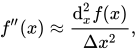
where we have introduced the shortcut  for simplicity such that
  which can be check by applying
  on
on  twice.
Approximating both derivatives in the wave equation, leads to the S-FD model,
twice.
Approximating both derivatives in the wave equation, leads to the S-FD model,
![{\displaystyle \left[{\text{d}}_{t}^{2}-(v\Delta t/\Delta x)^{2}{\text{d}}_{x}^{2}\right]\Psi (x,t)=0.}](https://wikimedia.org/api/rest_v1/media/math/render/svg/04e7cad46eef4f2e756e7b9a1715123a392eb3aa)
If you insert the solution  of the wave equation (with
  )into the S-FD model you find that
![{\displaystyle \left[{\text{d}}_{t}^{2}-(v\Delta t/\Delta x)^{2}{\text{d}}_{x}^{2}\right]\phi (x,t)=\epsilon .}](https://wikimedia.org/api/rest_v1/media/math/render/svg/63429e0bdfa6aa9d9a4a8c51afff33542c5bea2a)
In general  because the solution of the FD approximation to the wave equation is not the same as the wave equation itself.
To construct a NS-FD model which has the same solution as the wave equation, put a free parameter, call it u, in place of  and try to find a value of u which makes
  .
It turns out that this value of u is
.
It turns out that this value of u is
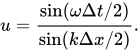
Thus an exact nonstandard finite difference model of the wave equation is
![{\displaystyle \left[{\text{d}}_{t}^{2}-(u\Delta t/\Delta x)^{2}{\text{d}}_{x}^{2}\right]\Psi (x,t)=0.}](https://wikimedia.org/api/rest_v1/media/math/render/svg/56f75626417ea3dc0b20dd57bf93ab6987f5e3d0)
Further details and extensions of to two and three dimensions as well as to Maxwell's equations can be found in Cole 2002.
[2]