November 12 (Eastern Orthodox liturgics)
Day in the Eastern Orthodox liturgical calendar
From Wikipedia, the free encyclopedia
November 11 - Eastern Orthodox liturgical calendar - November 13

All fixed commemorations below celebrated on November 25 by Eastern Orthodox Churches on the Old Calendar.[note 1]
For November 12th, Orthodox Churches on the Old Calendar commemorate the Saints listed on October 30.
Saints
- Prophet Ahijah the Shilonite (Achias) (960 BC)[1][2][3][note 2]
- Martyr Arsacius (Arsakios), by the sword.[3][5]
- Martyrs Anthony, Zevinus, Germanus, Nicephorus and virgin-martyr Maratho, under Diocletian (c. 286â305)[3][6][note 3] (see also: November 13)
- Saint Martin of Terracina, Bishop of Terracina (c. 4th century)[7][note 4] (see also: November 10)
- Venerable Martin the Merciful (Martin of Tours), Bishop of Tours (397)[3][8] (see also: October 12, November 11, July 4)
- Venerable Nilus the Faster, of Sinai (451)[1][3][9][10][note 5]
- Saint John the Merciful, Patriarch of Alexandria (c. 616â620)[1][3][12][13]
Pre-Schism Western saints
- Saint Rufus of Avignon, venerated as the first Bishop of Avignon in France (c. 200)[11][14]
- Saint Renatus (René), Bishop of Angers in France, and by tradition of Sorrento in the south of Italy (c. 422)[14]
- Saint Evodius, Bishop of Le Puy in France (c. 560)[14]
- Saint Emilian of Cogolla, Hermit, of Vergegio in Spain (574)[1][14][15][16][note 6][note 7]
- Saint Machar (Macharius, Mochumna), Bishop of Aberdeen (6th century)[1][15][note 8]
- Saint Sinnell of Cleenish (Senilis), Ireland (6th century)[1][15]
- Saint Himerius (Imier), a hermit in the Jura in Switzerland, now called after him Immertal, Val-Saint-Imier (c. 610)[14]
- Saint Cummian Fada (Cumianus), a monk at Clonfert, who founded the monastery of Kilcummin (662)[14]
- Saint Cunibert, Bishop of Cologne in Germany, an untiring builder of churches and monasteries (c. 663)[11][14]
- Saint Cadwaladr (Catuvelladurus), King of the Welsh (664)[1][14][15][note 9]
- Saint Paternus, born in Brittany, he was a monk at Cessier and then at Saint-Pierre-le-Vif near Sens in France, murdered by evildoers (c. 726)[11][14]
- Saint Lebuinus (Liafwine, Leafwine), Apostle of the Frisians and patron of Deventer (c. 773)[14][15][17][note 10]
- Saint Namphasius (Namphrase), a hermit near Marcillac in France, after a military career (c. 800)[14]
- Saint Ymar, a monk at the monastery of Reculver in Kent in England, martyred by the Danes (c. 830)[14]
- Saints Benedict, John, Matthew, Isaac and Christinus (Christian), monks from Italy who followed St Adalbert of Prague, murdered at their monastery near Gnesen, Poland (1005)[14][note 11]
- Saint Astericus of Pannonhalma (Astricus, Ascrick), first Abbot of BÅevnov Monastery, then first Abbot of Pannonhalma, and Archbishop of Kalocsa (c. 1035)[14]
Post-Schism Orthodox saints
- Saint Leontius (Leo), Patriarch of Constantinople (1143)[1][3][18]
- Blessed John "the Hairy", Fool-for-Christ, of Rostov (1580)[1][15][19]
- Venerable Nilus the Myrrh-gusher, of Mount Athos (1651)[1][3][20][21]
New martyrs and confessors
- New Martyr Mark Peter Markoulis of Kleisoura (1598)[22][23]
- New Martyr Sabbas Nigdelis the Samoladan, beheaded at Koutzouk-Karamani, Constantinople, buried in EÄri Kapı ("Crooked Gate") (1726)[1][3][24][25]
- New Martyr Nicholas of Six Marmara, at Constantinople (1732)[1][3][26]
- New Martyrs and Confessors of NÄsÄud, Romania (1763):[1]
- Athanasius Todoran, Basil Dumitru, Gregory Manu, and Basil Oichi
- New Hieromartyr Alexander Adrianov, priest of the Ekaterinburg Diocese (1918)[27][note 12]
- New Hieromartyrs Constantine Uspensky, Vladimir Krasnovsky, Alexander Archangelsky, Matthew Aloin and Demetrius Rozanov, Priests (1937)[15][28]
- New Hieromartyr Boris (1942)[15]
- New Confessor Varnava NastiÄ, Bishop of Hvosno (1964)[29]
Other commemorations
- Icon of the Mother of God "Kykkiotissa" ("The Merciful", "Milostivaya"), from Kykkos Monastery on Cyprus.[28][30][31] (see also: December 26 )
- Commemoration of the miracle (1718) of Saint Spyridon the Wonderworker (348), when the Latins wanted to place their own altar in his church on Corfu.[32]
- Repose of Righteous Cosmas of Birsk (1882)[1]
- Commemoration of the righteous monks and laymen buried at Optina Monastery,[33] including:[1]
- Virgin maiden Barbara (1900);
- Hieromonk Basil; Riassaphore-monks Trophimus and Therapontus (1993);
- the youth George (1994)
Icon gallery
 Prophet Ahijah the Shilonite.
 St. Martin the Merciful (Martin of Tours).
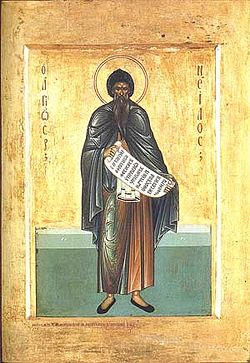 Venerable Nilus the Faster, of Sinai.
 Blessed John "the Hairy", Fool-for-Christ, of Rostov.

.jpg)


Notes
- The notation Old Style or (OS) is sometimes used to indicate a date in the Julian Calendar (which is used by churches on the "Old Calendar").
The notation New Style or (NS), indicates a date in the Revised Julian calendar (which is used by churches on the "New Calendar"). - "The Holy Prophet Ahijah, (cf. 1/3 Kgs 11:29 ff.) was a contemporary of Solomon, and was born in the city of Shiloh. The prophet predicted to Jeroboam his kingly rule over the ten Tribes of Israel, which God would grant him, snatching them away from the hands of Solomon. Afterwards Ahijah predicted to Jeroboam the perishing of all his line. All the predictions of the prophet were fulfilled. The Prophet Ahijah died in old age 960 years before the birth of Christ."[4]
- The martyrs Anthony, Zevinus, Germanus and Nicephorus were beheaded in Caesarea, while Virgin-martyr Maratho was burned alive in Scythopolis in Syria Palaestina.[6]
- He was a renowned Illyrian from Savaria in Pannonia, pious and virtuous. For defending Orthodoxy, the Arians publicly abused him and exiled him from the city. Therefore he fled to Milan, in Italy, but he suffered there as well, by the Arian bishop of that city, named Auxentius. He was then forced to retire to the island of Galerian in the Tyrrhenian Sea, which was entirely deserted. He sustained himself by eating the vegetation there. Later, he became the Bishop of Terracina, and excelled in his ecclesiastical duties. He nourished the poor, defended the aggrieved, and righteously pastored the flock entrusted to him. He reposed peacefully.
- A poor shepherd in La Rioja in Spain, he became a hermit and was later ordained priest for the parish of Berceo. The saint, however, returned to his life as a hermit. A large number of disciples gathered around him and he became their abbot. This gave rise to the monastery of La Cogolla. In Spain he is known as San Millan de la Cogolla.
- Born in Ireland, he was baptised by St Colman and became a disciple of St Columba at Iona in Scotland. Later he went with twelve disciples to convert the Picts near Aberdeen.
- "ST. CADWALADOR, called the last King of Britain, of the ancient British race, was the son of the ferocious Cadwallon, who fell in the Battle of Heavenfield, in an encounter with St. Oswald. Cadwalador was venerated as a Saint in Wales, and is named in the calendars of that country. Of his Acts we know little or nothing; but it appears that either he died of the plague in Wales, or, flying from the terrible epidemic, died in Brittany. (The story of his abdicating and going to Rome and dying there, appears to arise from a confusion between Cadwalador and Ceadwalla, King of Wessex)."[17]
- A monk at Ripon in England, he went to Holland and took part in the work begun by St Boniface. He worked with St Marcellinus under St Gregory of Utrecht and founded a church in Deventer. From there he preached to the Saxons and the Frisians.
- "Fr. Alexander Adrianov was a zealous priest of the Ekaterinburg Diocese whose whole life was consumed by service to his flock and love for others. In the autumn of 1918, Fr. Alexander was the sole priest remaining in his area, as several others fled following the Bolsheviksâ killing of several clergy. He continued zealously serving and preaching. Fr. Alexander was arrested in the night of November 8/21 during a Divine service and was shot soon thereafter on November 12/25. According to one eyewitness, Fr. Alexander died with a prayer on his lips. His body was found five days later, lightly covered with snow, with his arms crossed over his chest."[27]