Nunzio Nasi
Italian politician from Trapani, minister and parliamentarian
From Wikipedia, the free encyclopedia
Nunzio Nasi (April 1850 – 17 September 1935) was an Italian liberal politician from Trapani, a long-serving deputy and twice a cabinet minister. He was at the centre of the caso Nasi (1904–07), a corruption case, and later joined the Aventine opposition to Fascism before losing his seat in 1926. He died in Erice in 1935.[1][2]

Nunzio Nasi | |
|---|---|
Bust of Nunzio Nasi, Balio Gardens, Erice | |
| Minister of Public Instruction | |
| In office 15 February 1901 – 3 November 1903 | |
| Prime Minister | Giuseppe Zanardelli |
| Minister of Posts and Telegraphs | |
| In office 1898–1899 | |
| Prime Minister | Luigi Pelloux |
| Personal details | |
| Born | April 1850 Trapani, Sicily, Kingdom of the Two Sicilies |
| Died | 17 September 1935 (aged 85) Erice, Sicily, Kingdom of Italy |
| Occupation | Politician |
Biography
Nasi was born in Trapani in April 1850 and graduated in law in 1873. After early work in education administration and journalism in Trapani, he entered municipal and provincial politics and was elected to the Chamber of Deputies in 1886, holding the seat (with re-elections) until 1926.[1]
He served as Minister of Posts and Telegraphs in the first Pelloux government (1898–1899) and as Minister of Public Instruction in the Zanardelli Cabinet (1901–1903).[1][3]
As minister, he promoted the opening of the ginnasio (classical secondary school) "Vittorio Emanuele III" in Erice in 1900, housed in the former Santa Teresa monastery (today the campus of the Istituto di Istruzione Superiore Ignazio e Vincenzo Florio).[4]
In 1904 a parliamentary inquiry alleged abuses and irregularities during his time at the education ministry. Nasi fled abroad before returning to face proceedings; after jurisdictional disputes, the case went before the Senate as High Court in 1907, amid large demonstrations of support in Sicily. He received an 11-month sentence for peculation; nevertheless, he continued to be repeatedly re-elected by his constituency.[1]
In the 1920s Nasi aligned with anti-Fascist deputies (the Aventine opposition). In 1926 the regime declared him and the other Aventine deputies deprived of their mandates.[1]
He died in Erice in 1935.[2]
Commemoration
Nasi’s half-bust stands in the Balio Gardens at Erice; a local report notes the location near the approach to the Balio Towers.[5] Erice also commemorates him with Viale Nunzio Nasi.[6] In Trapani, his seaside residence Villino Nasi (1898, by engineer Giuseppe Manzo) is a noted landmark.[7][8]
Gallery
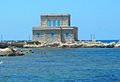 Villino Nasi
 Palazzo Sales (location of state ginnasio)


Notes
- Some sources give 2 April 1850 (Treccani) or 3 April 1850 (Camera dei deputati) as Nasi’s birth date; the bust in Erice’s Balio Gardens inscribes 13 April 1850. This article follows the parliamentary date for the death (17 September 1935) and uses "April 1850" for the birth in light of the discrepancy.[1][2][9]