One, Two, Three, Four, Five
Traditional nursery rhyme
From Wikipedia, the free encyclopedia
"One, Two, Three, Four, Five" (also known as "1, 2, 3, 4, 5" or "1, 2, 3, 4, 5, Once I Caught a Fish Alive" in other versions) is a nursery rhyme and counting-out rhyme.[1]

| "One, Two, Three, Four, Five" | |
|---|---|
| |
| Nursery rhyme | |
| Published | c. 1765 |
It has a Roud Folk Song Index number of 13530.[2]
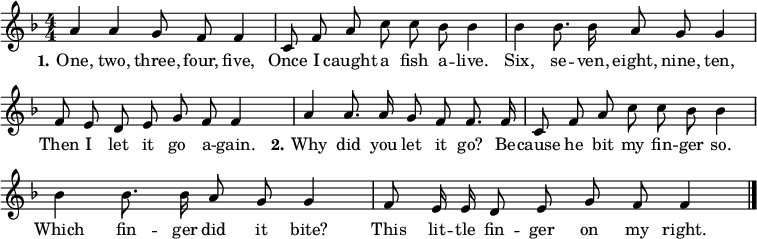
Text and melody
A common modern version is:
One, two, three, four, five,
Once I caught a fish alive.
Six, seven, eight, nine, ten,
Then I let it go again.
Why did you let it go?
Because he bit my finger so.
Which finger did it bite?
This little finger on my right.[3]
Origin

"One, Two, Three, Four, Five" is one of many counting-out rhymes. It was first recorded in Mother Goose's Melody around 1765. Like most versions until the late 19th century, it had only the first stanza and dealt with a hare, not a fish:
- One, two, three,
- Four and five,
- I caught a hare alive;
- Six, seven, eight,
- Nine and ten,
- I let him go again.[1]
The modern version is derived from three variations collected by Henry Bolton in the 1880s from America.[1]
