Opel Mokka
Subcompact crossover SUV
From Wikipedia, the free encyclopedia
The Opel Mokka is a subcompact crossover SUV that has been produced by German automaker Opel since 2012. Sales began with the model year of 2013, at the end of 2012.[1] The first generation was developed by GM Korea as the Buick Encore. The facelifted Opel Mokka was marketed as the Mokka X, before reverting to Mokka for the second generation. It is also sold under the Vauxhall brand in the United Kingdom. The Chevrolet Trax that is sold in North America, Australia and South America was also derived from the Buick Encore but the lines diverged after Opel became part of Stellantis.

- General Motors (Opel Mokka A)
- Stellantis (Opel Mokka B)
| Opel Mokka | |
|---|---|
| |
| Overview | |
| Manufacturer |
|
| Production | 2012–present |
| Body and chassis | |
| Class | Subcompact crossover SUV (B) |
| Body style | 5-door SUV |
The second generation Mokka was launched in 2020 after a brief hiatus. It marked the switch to PSA platform, after the acquisition of Opel and Vauxhall brands in 2017.
Mokka A (J13; 2012)
| Mokka A | |
|---|---|
 | |
| Overview | |
| Manufacturer | Opel (General Motors) |
| Model code | J13 |
| Also called |
|
| Production |
|
| Model years | 2013–2022 (Buick) |
| Assembly | |
| Designer | |
| Body and chassis | |
| Layout | Front-engine, front-wheel drive/four-wheel-drive |
| Platform | GM Gamma II platform |
| Related | Chevrolet Trax[5] |
| Powertrain | |
| Engine | |
| Power output | From 90 kW (120 hp) to 170 kW (230 hp) (Overboost) |
| Transmission | |
| Dimensions | |
| Wheelbase | 2,555 mm (100.6 in) |
| Length | 4,280 mm (168.5 in) |
| Width | 1,775 mm (69.9 in) |
| Height | 1,646 mm (64.8 in) |
| Kerb weight |
|
The Mokka was positioned below the Antara and the Zafira Tourer in the Opel line-up, and was available in both front wheel and four wheel drive versions. The Mokka name derives from the small, round coffee beans of the Coffea Arabica variety. The Mokka A is based on GM's Gamma II platform.
The four wheel drive option was an intelligent AWD system that maintains 100% drive at the front wheels until the system detects slip, fast starts or tight cornering, in which case it can send up to 50% of torque to the rear wheels.[6]
Production and sales started in autumn of 2012. By February 2013, Opel had over 80,000 Mokka orders, and after two months 100,000 orders. By October 2014, over 300,000 Mokkas were ordered in Europe. In January 2016, Opel announced 500,000 firm orders for Mokka overall.[7]
In 2019, Opel ceased production of the first generation Mokka as part of Opel/Vauxhall's full switch to Groupe PSA car platforms. However, it remained in production by GM Korea as the Buick Encore for North America until the Encore was discontinued in 2022.
The Chevrolet/Holden Trax is derived from the Mokka (and Encore), only with unique sheet metal and trim.[5]
 Opel Mokka (pre-facelift)
 Interior (pre-facelift)
 Vauxhall Mokka
.jpg)


Facelift
In April 2016, Opel and Vauxhall unveiled an updated version of the Mokka for the model year of 2017, designated as the Mokka X, which went on sale in the end of 2016. The new Mokka X received a facelift with new headlights, restyled bumpers, new LED tail lights, and a revised interior with an all new dashboard, instrument cluster, and centre stack. The more powerful optional 152 PS (112 kW; 150 hp) petrol engine was also introduced with the Mokka X.[8][9]
 Opel Mokka X (facelift)
 Opel Mokka X (facelift)
 Vauxhall Mokka X (facelift)
 Interior (facelift)
_–_Frontansicht,_23._Dezember_2016,_Düsseldorf.jpg)
_–_Heckansicht,_23._Dezember_2016,_Düsseldorf.jpg)
_Petrol_-_Lava_Red_-_03-2024,_Front.jpg)
_–_Innenraum,_23._Dezember_2016,_Düsseldorf.jpg)
Mokka by Bitter
Bitter has been producing a luxury version of the Mokka since 2016. Facelifted in the end of 2016 along with the Vauxhall and Opel models, the name was also changed to Mokka X.[10] The differences between the Bitter and Opel versions are mainly cosmetic.[11]
Engines
As introduced in 2012, the Mokka was offered with a choice of three engines: a 115 PS (85 kW; 113 bhp) 1.6-litre petrol, a 140 PS (103 kW; 138 bhp) 1.4-litre turbo petrol, and a 130 PS (96 kW; 128 hp) 1.7-litre diesel.[12][13]
Other petrol and diesel engines were offered later, including a 152 PS (112 kW; 150 bhp) 1.4-litre direct injection turbo petrol engine with a controversial[clarification needed] start/stop feature introduced for model year 2016.
Most engines are paired standard with the 5-speed (1.6-litre MPI petrol engine only) or 6-speed manual transmission, with stop/start engine technology beginning as early as model year 2014. A six speed automatic transmission having active select mode is optionally available for select petrol and diesel engines including the 1.4-litre MPI Turbo petrol and 1.7-litre CDTI diesel engines for both FWD and AWD models.
Start/Stop technology on vehicles with automatic transmissions first appeared with the introduction of the new, more powerful (112 kW; 150 hp), B14XFT 1.4-litre direct injection (DI) VVT Turbo petrol engine for model year 2016 and was incorporated on other select petrol and diesel engines paired with automatic transmissions by model year 2018.
For the Russian market a version with the 1.8-litre A18XER (Korean designation F18DA) petrol engine is available. The cars for the Russian market were assembled by Avtotor (Kaliningrad, Russia) and later by Unison (Minsk, Belarus) from 2015.[14] In October 2014, for the model year of 2015, Opel introduced its all new "whisper diesel" 1.6-litre CDTI engine which replaced the 1.7-litre CDTI diesel. The engine specifications in the following tables is from the 2013, 2015, and 2018 Opel owner manual.[15][16][17]
| Petrol engines | |||||||
|---|---|---|---|---|---|---|---|
| Model | Engine | Displacement | Power | Torque | Engine ID Code | CO2 emission (g/km) | Years |
| 1.4L VVT MPI Turbo | I4 | 1364 cc | 120 PS (88 kW; 118 hp) at 4900–6000 rpm to 232 PS (171 kW; 229 hp) (Overboost) | 200 N⋅m (148 lb⋅ft) at 1850–4900 rpm to 420 N⋅m (310 lb⋅ft) (Overboost) | A14NET | 160 | 2013–2019 |
| 140 PS (103 kW; 138 hp) at 4900–6000 rpm | 200 N⋅m (148 lb⋅ft) at 1850–4900 rpm | B14NET | 153 | 2013–2019 | |||
| 1.4L VVT DI Turbo | 1399 cc | 152 PS (112 kW; 150 hp) at 4900–6000 rpm | 235 N⋅m (173 lb⋅ft) at 1850–4900 rpm | B14XFT | 155 | 2016–2019 | |
| 1.6L VVT MPI | 1598 cc | 115 PS (85 kW; 113 hp) at 6200 rpm | 155 N⋅m (114 lb⋅ft) at 4000 rpm | A16XER B16XER | 139 | 2013–2019 | |
| 1.8L VVT MPI | 1796 cc | 140 PS (103 kW; 138 hp) at 6200 rpm | 178 N⋅m (131 lb⋅ft) at 3800 rpm | A18XER | 225 (FWD, MT5), 257 (AWD, AT6) | 2013–2019 | |
| Diesel engines | |||||||
|---|---|---|---|---|---|---|---|
| Model | Engine | Displacement | Power | Torque | Engine ID Code | CO2 emission (g/km) | Years |
| 1.6L CDTI ecoFLEX | I4 | 1598 cc | 110 PS (81 kW; 108 hp) at 4000 rpm | 300 N⋅m (221 lb⋅ft) at 2000–2250 rpm | B16DTN B16DTU | 114–109 | 2015–2019 |
| 1.6L CDTI Turbo ecoFLEX | 1598 cc | 136 PS (100 kW; 134 hp) at 3500–4000 rpm | 320 N⋅m (236 lb⋅ft) at 2000–2250 rpm | B16DTH | 109–119 | 2015–2019 | |
| 1.7L CDTI ecoFLEX | 1686 cc | 130 PS (96 kW; 128 hp) at 4000 rpm | 300 N⋅m (221 lb⋅ft) at 2000–2500 rpm | A17DTS | 120–129 | 2013–2015 | |
Engine code prefix B indicates Start/Stop technology. B14NET is also available for LPG.
Mokka B (P2QO, 2021)
| Mokka B | |
|---|---|
 | |
| Overview | |
| Manufacturer | Opel (Stellantis) |
| Also called | Vauxhall Mokka (United Kingdom) |
| Production | 2020–present |
| Assembly | France: Poissy (Poissy Plant)[18] |
| Body and chassis | |
| Platform | PSA CMP (EMP1) platform |
| Related | |
| Powertrain | |
| Engine | |
| Electric motor | Permanent Magnet Synchronous Motor (Mokka-e) |
| Transmission |
|
| Hybrid drivetrain | Mild-Hybrid |
| Battery | 0.43 kWh (Hybrid) 50 kWh lithium-ion |
| Electric range | 322 km (200 mi) (WLTP) |
| Dimensions | |
| Wheelbase | 2,557 mm (100.7 in) |
| Length | 4,151 mm (163.4 in) |
| Width | 1,791 mm (70.5 in) |
| Height | 1,531 mm (60.3 in) |
| Kerb weight |
|
The second-generation Mokka (B) was announced in August 2018 by the show car Opel GT X Experimental concept, and unveiled on 24 June 2020.[19] Now based on the ex-PSA Group's Common Modular Platform (CMP), the car is available with an electric version dubbed as the Mokka-e.[20]
The ICE version was unveiled on 2 September 2020. Sales of the second-generation Mokka began with the model year of 2021, on 23 December 2020. The production model assembly started in January 2021.[21] There are three engine options, including a 1.2-litre turbocharged three-cylinder petrol rated at 100 PS (74 kW; 99 bhp) and 205 N⋅m (151 lb⋅ft) of torque with a 6-speed manual transmission and a 1.2-litre turbo making 130 PS (96 kW; 128 bhp) and 230 N⋅m (170 lb⋅ft) of torque in combination with a standard 6-speed manual or 8-speed automatic transmissions. While the only diesel engine on offer is a 1.5-litre four-cylinder rated at 110 PS (81 kW; 108 bhp) and 250 N⋅m (184 lb⋅ft) of torque, offered exclusively with a 6-speed manual transmission.[22] The diesel engine was removed from the lineup in August 2022.[23][24]
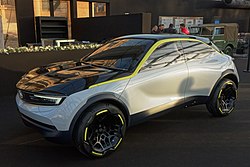 Opel GT X Experimental
 Opel GT X Experimental
 Opel Mokka GS Line (rear view)
 Interior (pre-facelift)
 Vauxhall Mokka (front view, pre-facelift)
 Vauxhall Mokka (rear view, pre-facelift)


| Engines | ||||||||
|---|---|---|---|---|---|---|---|---|
| Petrol | ||||||||
| Model | Engine | Displacement | Power | Torque | Engine ID Code | CO2 emission (g/km) | Transmission | Years |
| 1.2L VVT MPI Turbo | I3 | 1199 cc | 100 PS (74 kW; 99 hp) at 5500 rpm | 205 N⋅m (151 lb⋅ft) at 1750 rpm | EB2ADTD/F12XHL | 125 | 6–speed manual | 2021–2024 |
| 136 PS (100 kW; 134 hp) at 5500 rpm | 230 N⋅m (170 lb⋅ft) at 1750 rpm | EB2ADTS/F12XHT | 128 | 6–speed manual | 2021– | |||
| 130 PS (96 kW; 128 hp) at 5500 rpm | 230 N⋅m (170 lb⋅ft) at 1750 rpm | 138 | 8–speed automatic | 2021– | ||||
| 145 PS (107 kW; 143 hp) at 5500 rpm | 230 N⋅m (170 lb⋅ft) at 1750 rpm | EB2LTEDH2 | 109 | 6-speed dual–clutch transmission | 2024– | |||
| Diesel | ||||||||
| Model | Engine | Displacement | Power | Torque | Engine ID Code | CO2 emission (g/km) | Transmission | Years |
| 1.5L Turbo | I4 | 1499 cc | 110 PS (81 kW; 108 hp) at 3500 rpm | 250 N⋅m (184 lb⋅ft) at 1750 rpm | F15DT | 117 | 6–speed manual | 2021–2022 |
Mokka-e
The Mokka-e, the all-electric version of the Mokka, is powered by a 50 kWh lithium-ion battery with a WLTP range of 322 km (200 mi). Three driving modes are available, Sport, Eco and Normal.[25]
 Opel Mokka-e
 Vauxhall Mokka-e
 Battery configuration


Facelift
A facelift was unveiled on 23 October 2024. There are minimal exterior changes but there are updated lighting graphics, the brand's visor front fascia features the new logo, and new black exterior accents replaced the chrome inserts. Inside, there is a new steering wheel, updated software for the infotainment system, some functions that were previously controlled by buttons are integrated into the touchscreen, a new matte silver centre console and all fabrics are made from recycled content.[26][27]
 2025 Opel Mokka-e
 Rear view
 2025 Opel Mokka
 Interior (facelift)


Mokka GSE
The GSE sub-brand was teased in a press release on 14 May 2025[28]; with the Mokka being the first vehicle to receive a GSE variant on 23 July 2025.[29] It has a 207 kilowatts (281 PS; 278 hp) electric motor delivering 345 newton-metres (254 lb⋅ft) of torque, taking the car from 0–100 km/h (0–62 mph) in 5.9 seconds. The Mokka GSE has a top speed of 200 km/h (124 mph), making it the fastest all-electric production model Opel at the time of its reveal.[30] The Mokka GSE is sold in the United Kingdom as the Vauxhall Mokka GSE.
Upgrades
The Mokka GSE features "aerodynamically optimised" 20-inch alloy wheels paired with 225/40 R20 Michelin Sport Pilot EV tyres as standard (optionally available are Goodyear Eagle F1 Asymmetrical 3 tyres). The front brakes are 380mm discs with 4-piston calipers. Rear brakes are 268mm discs.
The Mokka GSE features a "completely new steering rack" tuned by GSE. The new steering rack has a ratio of 14.5 (compared to 16.2 in the standard Mokka), with a turning circle of 10.41 metres (34.2 ft). Other upgrades include a 10mm lower ride height, a limited slip differential, and a "new rear axle design".[31] The Mokka GSE is the only variant of the Mokka sold in the United Kingdom with the optional black bonnet.
Safety
ANCAP

Euro NCAP

Awards
In June 2022, the Mokka-e won Auto Trader UK's New Car Award for the Erin Baker Award.[34] Auto Trader awarded the Mokka-e four stars out of five in its review of the car.[35]
Sales
- Europe: 2020 EU 27 + UK + Switzerland + Norway + Iceland
