Open set condition
From Wikipedia, the free encyclopedia

In fractal geometry, the open set condition (OSC) is a commonly imposed condition on self-similar fractals. In some sense, the condition imposes restrictions on the overlap in a fractal construction.[1] Specifically, given an iterated function system of contractive mappings , the open set condition requires that there exists a nonempty, open set V satisfying two conditions:

- The sets are pairwise disjoint.
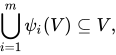

Introduced in 1946 by P.A.P Moran,[2] the open set condition is used to compute the dimensions of certain self-similar fractals, notably the Sierpinski Gasket. It is also used to simplify computation of the packing measure.[3]
An equivalent statement of the open set condition is to require that the s-dimensional Hausdorff measure of the set is greater than zero.[4]
When the open set condition holds and each is a similitude (that is, a composition of an isometry and a dilation around some point), then the unique fixed point of is a set whose Hausdorff dimension is the unique solution for s of the following:[5]


where ri is the magnitude of the dilation of the similitude.
With this theorem, the Hausdorff dimension of the Sierpinski gasket can be calculated. Consider three non-collinear points a1, a2, a3 in the plane R2 and let be the dilation of ratio 1/2 around ai. The unique non-empty fixed point of the corresponding mapping is a Sierpinski gasket, and the dimension s is the unique solution of

Taking natural logarithms of both sides of the above equation, we can solve for s, that is: s = ln(3)/ln(2). The Sierpinski gasket is self-similar and satisfies the OSC.