Oper (mathematics)
From Wikipedia, the free encyclopedia
In mathematics, an oper is a principal connection, or in more elementary terms a type of differential operator. They were first defined and used by Vladimir Drinfeld and Vladimir Sokolov[1] to study how the KdV equation and related integrable PDEs correspond to algebraic structures known as Kac–Moody algebras. Their modern formulation is due to Drinfeld and Alexander Beilinson.[2]
Opers were first defined, although not named, in a 1981 Russian paper by Drinfeld and Sokolov on Equations of Korteweg–de Vries type, and simple Lie algebras. They were later generalized by Drinfeld and Beilinson in 1993, later published as an e-print in 2005.
Formulation
Abstract
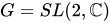
Let be a connected reductive group over the complex plane , with a distinguished Borel subgroup . Set , so that is the Cartan group.



![{\displaystyle N=[B,B]}](https://wikimedia.org/api/rest_v1/media/math/render/svg/9c197ef9f0b53ab55100c827b079ab25b7aa869d)

Denote by and the corresponding Lie algebras. There is an open -orbit consisting of vectors stabilized by the radical such that all of their negative simple-root components are non-zero.


Let be a smooth curve.

A G-oper on is a triple where is a principal -bundle, is a connection on and is a -reduction of , such that the one-form takes values in .