The costs and benefits in the optimization models can generally be simplified into two attributes: the distance between the new node, and the existing one; and the distance of the existing node from the central node. Thus the goal function can be written in the following form:
![{\displaystyle C_{i}=min_{j}[\delta *d_{ij}+h_{j}]}](https://wikimedia.org/api/rest_v1/media/math/render/svg/fd70aa532f04386fde1ffb61860e09074b2d6ddc)
- where
 stands for the minimal cost of attaching node 'i' to an existing node
 denotes the distance between node 'i' and 'j'
 represents the distance of node 'j' from the central node
 is a parameter, that determines the weight of the individual distance compared to the distance to the central node, and thus it varies across different settings.
In a highway network setting - where cities are nodes and links are highways - would be the physical distance between cities, and would be the distance from the capital (or from the central city of the region). The value of determines the type of the network built by the optimization mechanism.[2]
The optimization mechanism results in a star network, whenever  . A unique feature of the star network is that most of the newly added nodes will connect to the central node regardless of the distance. One can think of a star network as a network in which the costs to establish a new link are negligible compared to the benefit of being directly connected to the central node. Star networks are rarely observed in reality.
A random network is built using the optimization method when  . In case of a high enough , the costs to establish a new link are enormously high, compared to the benefit of being closely connected to the central node. As a result, most of the new nodes will connect to the closest node available. A real life example is the power grid network, where the cost of building a power line is high, and the benefits of being directly connected to the power source is negligible.
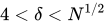 . If is neither too high, nor too low, the mechanism results in a scale-free network, characterised by preferential attachment. The newly added nodes tend to connect to the larger nodes, but sometimes they may connect to middle-size nodes, or even small ones, depending on their distance. Most of the real-life networks characterized by an underlying optimization mechanism are scale-free networks, such as the router network and the highway network.