Orbital magnetization
From Wikipedia, the free encyclopedia
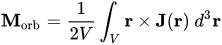
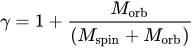
In quantum mechanics, orbital magnetization, Morb, refers to the magnetization induced by orbital motion of charged particles, usually electrons in solids. The term "orbital" distinguishes it from the contribution of spin degrees of freedom, Mspin, to the total magnetization. A nonzero orbital magnetization requires broken time-reversal symmetry, which can occur spontaneously in ferromagnetic and ferrimagnetic materials, or can be induced in a non-magnetic material by an applied magnetic field.
The orbital magnetic moment of a finite system, such as a molecule, is given classically by[1]
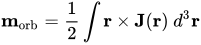
where J(r) is the current density at point r. (Here SI units are used; in Gaussian units, the prefactor would be 1/2c instead, where c is the speed of light.) In a quantum-mechanical context, this can also be written as
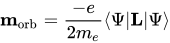
where −e and me are the charge and mass of the electron, Ψ is the ground-state wave function, and L is the angular momentum operator. The total magnetic moment is

where the spin contribution is intrinsically quantum-mechanical and is given by
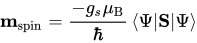
where gs is the electron spin g-factor, μB is the Bohr magneton, ħ is the reduced Planck constant, and S is the electron spin operator.
The orbital magnetization M is defined as the orbital moment density; i.e., orbital moment per unit volume. For a crystal of volume V composed of isolated entities (e.g., molecules) labelled by an index j having magnetic moments morb, j, this is
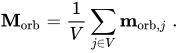
However, real crystals are made up out of atomic or molecular constituents whose charge clouds overlap, so that the above formula cannot be taken as a fundamental definition of orbital magnetization.[2] Only recently have theoretical developments led to a proper theory of orbital magnetization in crystals, as explained below.