Order polytope
From Wikipedia, the free encyclopedia
In mathematics, the order polytope of a finite partially ordered set is a convex polytope defined from the set. The points of the order polytope are the monotonic functions from the given set to the unit interval, its vertices correspond to the upper sets of the partial order, and its dimension is the number of elements in the partial order. The order polytope is a distributive polytope, meaning that coordinatewise minima and maxima of pairs of its points remain within the polytope.
The order polytope of a partial order should be distinguished from the linear ordering polytope, a polytope defined from a number as the convex hull of indicator vectors of the sets of edges of -vertex transitive tournaments.[1]

A partially ordered set is a pair where is an arbitrary set and is a binary relation on pairs of elements of that is reflexive (for all , ), antisymmetric (for all with at most one of and can be true), and transitive (for all , if and then ).


A partially ordered set is said to be finite when is a finite set. In this case, the collection of all functions that map to the real numbers forms a finite-dimensional vector space, with pointwise addition of functions as the vector sum operation. The dimension of the space is just the number of elements of . The order polytope is defined to be the subset of this space consisting of functions with the following two properties:[2][3]

- For every , . That is, maps the elements of to the unit interval.
- For every with , . That is, is a monotonic function
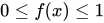

For example, for a partially ordered set consisting of two elements and , with in the partial order, the functions from these points to real numbers can be identified with points in the Cartesian plane. For this example, the order polytope consists of all points in the -plane with . This is an isosceles right triangle with vertices at (0,0), (0,1), and (1,1).



Vertices and facets
The vertices of the order polytope consist of monotonic functions from to . That is, the order polytope is an integral polytope; it has no vertices with fractional coordinates. These functions are exactly the indicator functions of upper sets of the partial order. Therefore, the number of vertices equals the number of upper sets.[2]

The facets of the order polytope are of three types:[2]
- Inequalities for each minimal element of the partially ordered set,
- Inequalities for each maximal element of the partially ordered set, and
- Inequalities for each two distinct elements that do not have a third distinct element between them; that is, for each pair in the covering relation of the partially ordered set.


The facets can be considered in a more symmetric way by introducing special elements below all elements in the partial order and above all elements, mapped by to 0 and 1 respectively, and keeping only inequalities of the third type for the resulting augmented partially ordered set.[2]


More generally, with the same augmentation by and , the faces of all dimensions of the order polytope correspond 1-to-1 with quotients of the partial order. Each face is congruent to the order polytope of the corresponding quotient partial order.[2]






