Orthogonality (term rewriting)
From Wikipedia, the free encyclopedia
Orthogonality as a property of term rewriting systems (TRSs) describes where the reduction rules of the system are all left-linear, that is each variable occurs only once on the left hand side of each reduction rule, and there is no overlap between them, i.e. the TRS has no critical pairs. For example is not left-linear.[1]
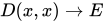
Orthogonal TRSs have the consequent property that all reducible expressions (redexes) within a term are completely disjoint—that is, the redexes share no common function symbol.
For example, the TRS with reduction rules is orthogonal—it is easy to observe that each reduction rule is left-linear, and the left hand side of each reduction rule shares no function symbol in common, so there is no overlap.

Orthogonal TRSs are confluent.


