Osaka Municipal Subway 66 series
From Wikipedia, the free encyclopedia
In service1990–present
ManufacturerKawasaki Heavy Industries, Kinki Sharyo
Replaced60 series
Constructed1990–2003
| Osaka Municipal Subway/Osaka Metro 66 series | |
|---|---|
 66611 on a service to Tengachaya | |
| In service | 1990–present |
| Manufacturer | Kawasaki Heavy Industries, Kinki Sharyo |
| Replaced | 60 series |
| Constructed | 1990–2003 |
| Entered service | 1 August 1990 |
| Refurbished | 2012–2023 |
| Number built | 136 vehicles (17 sets) |
| Number in service | 136 vehicles (17 sets) |
| Formation | 8 cars per trainset |
| Fleet numbers | 66601–66617[citation needed] |
| Operators | Osaka Municipal Subway (1990–2018) Osaka Metro (2018–) |
| Lines served | |
| Specifications | |
| Car body construction | Stainless steel |
| Car length | 18,900 mm (62 ft 0 in) |
| Width | 2,845 mm (9 ft 4.0 in) |
| Height | 4,080 mm (13 ft 5 in) |
| Doors | 3 pairs per side |
| Maximum speed | 70 km/h (43 mph) (Sakaisuji Line) 110 km/h (68 mph) (Hankyu Lines) |
| Traction system | Variable-frequency |
| Traction motors | Squirrel-cage three-phase induction motor |
| Power output | 180 kW (241 hp) |
| Acceleration | 2.8 km/(h⋅s) (1.7 mph/s) |
| Deceleration | 3.5 km/(h⋅s) (2.2 mph/s) (service) 4.0 km/(h⋅s) (2.5 mph/s) (emergency) |
| Electric system(s) | 1,500 V DC overhead wire |
| Current collector(s) | Pantograph |
| Bogies | SS-120 / SS-020 |
| Braking system(s) | Electric commanding brake with regenerative brake |
| Safety system(s) | WS-ATC, Hankyu ATS |
| Track gauge | 1,435 mm (4 ft 8+1⁄2 in) |
The Osaka Municipal Subway/Osaka Metro 66 series (大阪市交通局・大阪メトロ66系) is a rapid transit electric multiple unit (EMU) train type operated by Osaka Municipal Subway in Japan since 1990.[1]
Seventeen eight-car sets were built to replace the older 60 series sets on the Sakaisuji Line.
The first 12 sets (96 cars) were built in 1990 while an expansion of 40 cars (5 sets) were introduced between 2002 and 2004.[1]
Formations
The Sakaisuji Line fleet consists of 17 eight-car trainsets formed as follows, with car 1 at the Tengachaya end.
← Tengachaya Tenjimbashisuji 6-chōme → | ||||||||
| Car No. | 1 | 2 | 3 | 4 | 5 | 6 | 7 | 8 |
|---|---|---|---|---|---|---|---|---|
| Designation | Tec1 | Ma1 | Mb1 | Tp' | T' | Mb2 | Ma2 | Tec2 |
| Numbering | 666xx | 660xx | 661xx | 667xx | 668xx | 663xx | 662xx | 669xx |
- The "Ma1" and "Ma2" cars are each fitted with two scissors-type pantographs.
Interior
Passenger accommodation consists of longitudinal seating throughout.
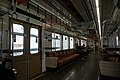 Interior of a "Tec1" car
 Drivers cabin of "Tec2" car 66908


