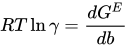
Osmotic coefficient
From Wikipedia, the free encyclopedia
An osmotic coefficient is a quantity which characterises the deviation of a solvent from ideal behaviour, referenced to Raoult's law. It can be also applied to solutes. Its definition depends on the ways of expressing chemical composition of mixtures.

The osmotic coefficient based on molality b is defined by:

and on a mole fraction basis by:
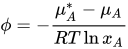
where is the chemical potential of the pure solvent and is the chemical potential of the solvent in a solution, MA is its molar mass, xA its mole fraction, R the gas constant and T the temperature in Kelvin.[1] The latter osmotic coefficient is sometimes called the rational osmotic coefficient. The values for the two definitions are different, but since


the two definitions are similar, and in fact both approach 1 as the concentration goes to zero.
For liquid solutions, the osmotic coefficient is often used to calculate the salt activity coefficient from the solvent activity, or vice versa. For example, freezing point depression measurements, or measurements of deviations from ideality for other colligative properties, allows calculation of the salt activity coefficient through the osmotic coefficient.