Overture, Scherzo and Finale
From Wikipedia, the free encyclopedia
The Overture, Scherzo and Finale (German: Ouvertüre, Scherzo und Finale) in E major is a work for symphony orchestra by Robert Schumann. It is his opus 52, and was written in 1841. Schumann originally considered it his second symphony.[1] The Overture, Scherzo and Finale was received tepidly by critics,[1] was revised in 1845[2] and published the next year,[2] with a dedication to Johannes Verhulst.
The work is in three movements:
- Overture. (Andante con moto in E minor[2] – Allegro in E major and
 time[3]) (sketched and completed in April 1841)[1]
- Scherzo. Vivo, in 6
8 time and in C♯ minor,[4] whose theme is based on that of the overture.[1] It has a trio section in D♭ major, in contrasting 2
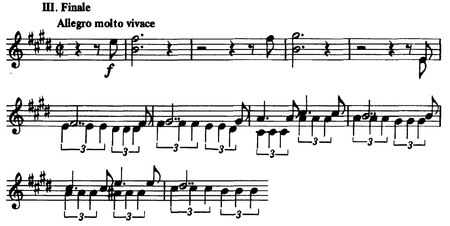
4 time[5] whose material reappears as the coda of the movement.[6] - Finale. Allegro molto vivace[2] (orchestrated around May 1841)[1]