Pachycereus weberi
From Wikipedia, the free encyclopedia
| Pachycereus weberi | |
|---|---|
.jpg) | |
Scientific classification  | |
| Kingdom: | Plantae |
| Clade: | Tracheophytes |
| Clade: | Angiosperms |
| Clade: | Eudicots |
| Order: | Caryophyllales |
| Family: | Cactaceae |
| Subfamily: | Cactoideae |
| Genus: | Pachycereus |
| Species: | P. weberi |
| Binomial name | |
| Pachycereus weberi | |
| Synonyms | |
| |
Pachycereus weberi is a columnar cactus plant native to Mexico.
Pachycereus weberi is a columnar cactus that grows strongly tree-like and can reach heights of up to 11 meters. The moderately upright growth habit is candelabra-shaped. However, this typical growth form is only achieved by the plant when it reaches a height of two meters, where numerous branches of the main trunk arise. The slightly waxy, bluish-green side shoots have a diameter of 12 to 20 centimeters and consist of eight to ten ribs, which are covered with white, felty areoles at a distance of 2 to 3 (up to 5) centimeters. The blackish, flattened central spine can be up to 10 centimeters long. It is accompanied by 6 to 12 reddish-brown marginal spines with a length of 2 to 3 centimeters.
The white to yellow flowers, which only open at night, are 8 to 10 centimeters long. The ovary is rounded and woolly. The flower tube is covered with scales and brown hairs. The edible fruits are 6 to 7 centimeters long and have fine yellowish thorns. The flesh is reddish-purple.[2]
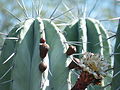 Flowers
 Spines
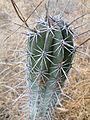 Tip of plant
.jpg)

.jpg)
Distribution
Pachycereus weberi is widespread in the Mexican states of Puebla, Guerrero, Morelos, Chihuahua and Oaxaca at altitudes of 600 to 1,500 m.
 Plants growing in Tomellin, Oaxaca
 Plant growing in San Juan De Los Cues, Oaxaca
 Large plant in Cuicatlan, Oaxaca
 Plants growing in habitat in Tomellin, Oaxaca
.jpg)
.jpg)
.jpg)
.jpg)

