Pandora (moon)
Moon of Saturn
From Wikipedia, the free encyclopedia
Pandora is an inner satellite of Saturn. It was discovered in 1980 from photos taken by the Voyager 1 probe and was provisionally designated S/1980 S 26.[5] In late 1985, it was officially named after Pandora from Greek mythology.[6] It is also designated as Saturn XVII.[7]

D. Carlson
Voyager 1
View of Pandora's western hemisphere.[a] | |
| Discovery | |
|---|---|
| Discovered by | Stewart A. Collins D. Carlson Voyager 1 |
| Discovery date | October 1980 |
| Designations | |
Designation | Saturn XVII |
| Pronunciation | /pænˈdɔːrə/ |
Named after | Πανδώρα Pandōra |
| Adjectives | Pandoran[1] |
| Orbital characteristics[2]: 7 | |
| 141712 km | |
| Eccentricity | 0.00419 |
| 0.628503 d | |
| Inclination | 0.050° |
| Satellite of | Saturn |
| Physical characteristics | |
| Dimensions | 103.0 × 79.0 × 63.0 km (± 0.6 × 0.6 × 0.4 km)[3]: 2 |
| 80.0±0.6 km[3]: 2 | |
| Volume | 268990±860 km3[4]: 4 |
| Mass | (1.357±0.002)×1017 kg[b] |
Mean density | 0.5045±0.0017 g/cm3[4]: 4 |
| 0.0022–0.0061 m/s2[3]: 3 | |
| 0.019 km/s at longest axis to 0.024 km/s at poles | |
| synchronous[3]: 4 | |
| assumed zero | |
| Albedo | 0.62±0.08[2]: 7 |
| Temperature | ≈ 78 K |
Pandora was thought to be an outer shepherd satellite of the F Ring. However, recent studies indicate that it does not play such a role, and that only Prometheus, the inner shepherd, contributes to the confinement of the narrow ring.[8][9] It is more heavily cratered than nearby Prometheus and has at least two large craters 30 kilometres (19 mi) in diameter. The majority of craters on Pandora are shallow as a result of being filled with debris. Ridges and grooves are also present on the moon's surface.[10]
The orbit of Pandora appears to be chaotic as a consequence of a series of four 118:121 mean-motion resonances with Prometheus.[11] The most appreciable changes in their orbits occur approximately every 6.2 years,[12] when the periapsis of Pandora lines up with the apoapsis of Prometheus and the moons approach to within about 1,400 kilometres (870 mi). Pandora also has a 3:2 mean-motion resonance with Mimas,[12] and also a 21:19 mean-motion resonance with Epimetheus, but only while it is on the outer orbit relative to Janus. No such configuration with Janus exists.[13]
Due to their gravitational interactions with the rings, Prometheus and Pandora are expected to crash into each other or Mimas in the next 20 million years.[14][15]
From its very low density and relatively high albedo, it seems likely that Pandora is a very porous icy body. However, there is much uncertainty in these values, so this remains to be confirmed.[needs update]
Gallery
 Voyager 2 image of Pandora (August 1981).
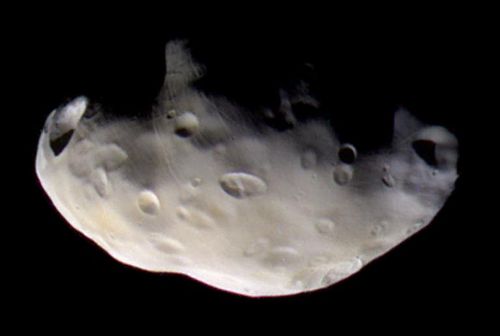 View of the moon, taken during September 2005 flyby by Cassini.
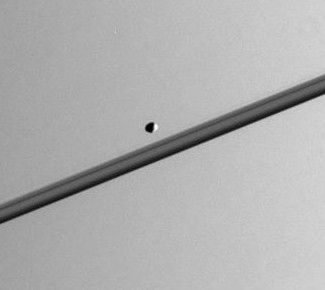 Pandora as seen from the Cassini probe in 2005; the rings of Saturn are in the background.
 Cassini captured this close view of Saturn's moon Pandora during the spacecraft's flyby on June 3, 2010.


_PIA_12690.png)

