Parmotrema
Genus of fungi
From Wikipedia, the free encyclopedia
Parmotrema is a genus of lichen belonging to the family Parmeliaceae.[1] It is a large genus, containing an estimated 300 species,[2] with a centre of diversity in subtropical regions of South America and the Pacific Islands.[3]
.jpg)
| Parmotrema | |
|---|---|
| |
| Parmotrema hypotropum | |
Scientific classification  | |
| Kingdom: | Fungi |
| Division: | Ascomycota |
| Class: | Lecanoromycetes |
| Order: | Lecanorales |
| Family: | Parmeliaceae |
| Genus: | Parmotrema A.Massal. (1860) |
| Type species | |
| Parmotrema perforatum (Wulfen) A.Massal. (1860) | |
| Synonyms | |
Members of the genus are commonly called ruffle lichens or scatter-rag lichens.[4]: 83
Description
Parmotrema is characterized by its typically large, moderately to loosely-attached foliose thallus with broad lobes that are usually more than 5 mm wide. There is a broad, naked zone around the margin of the lower surface, an epicortex with pores and an upper cortex with a palisade-plectenchymatous arrangement of hyphae. Ascospores are thick-walled and ellipsoid.[5]
Taxonomy
Parmotrema was proposed as a genus by Italian lichenologist Abramo Bartolommeo Massalongo in 1860, with Parmotrema perforatum as the type species.[6] The genus name, composed of the Greek parmos (cup) and trema (perforation), refers to the perforate apothecia. Parmotrema was largely ignored as a genus,[7] and its species were usually grouped in section Amphigymnia of the large genus Parmelia.[8] Several genera previously segregated from Parmotrema have since been folded back in owing to molecular phylogenetic evidence, including Canomaculina, Concamerella, Parmelaria, and Rimelia.[3][9]
Uses
Some species of Parmotrema can be used as a vegetable dye, such as P. crinitum. When mixed with pine sap or with water, or when first burnt to ash, lichens can provide a variety of colors such as yellow, brown, green, orange, purple, and red.[10] Some Parmotrema species also enter commerce as part of the lichen mixture known as "black stone flower", which is sold for culinary use under several regional names. Continued large-scale harvesting of commercially traded lichens may add to extinction risk when combined with habitat loss and climate change.[11]
Gallery
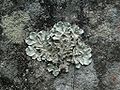
 Parmotrema chinense

.jpg)