Patera clarki nantahala
From Wikipedia, the free encyclopedia
| Patera clarki nantahala | |
|---|---|
 | |
Scientific classification  | |
| Domain: | Eukaryota |
| Kingdom: | Animalia |
| Phylum: | Mollusca |
| Class: | Gastropoda |
| Order: | Stylommatophora |
| Family: | Polygyridae |
| Genus: | Patera |
| Species: | |
| Subspecies: | P. c. nantahala |
| Trinomial name | |
| Patera clarki nantahala | |
| Synonyms | |
|
Polygyra (Triodopsis) nantahala[1] | |
Patera clarki nantahala, the noonday globe, is a subspecies of Patera clarki, a land snail in the family Polygyridae. It is endemic to North Carolina in the United States.
The name nantahala is a Cherokee word which means noonday. This subspecies was given this name because the snail lives in a deep gorge where the sunshine does not reach the ground until the middle of the day.[2]

The shell of the noonday globe snail is moderately sized (3/4 inch wide and 1/2 inch high) and globose in shape. The outer shell surface is shiny and reddish in color.
Shells of this subspecies often exhibit 5 and half whorls.[3] The shell surface is sculptured with rather coarse lines. The area around the shell opening (aperture) is white, and a long curved "tooth" is located on the inside portion of the aperture.
The width of the shell is 18 mm. The height of the shell is 11 mm.[3]
The body is black.
Distribution

Patera clarki nantahala is endemic to North Carolina, where it is known only from the Nantahala Gorge in Swain County in the Appalachian Mountains.[4] It occurs along about two miles of high cliffs on the eastern side of the gorge.[3]
This subspecies was probably never widely distributed. Its native habitat of steep wet slopes with calcareous rocks is rare in western North Carolina. It probably had a wider range before the gorge underwent the construction of a railroad and U.S. Route 19. Both of these projects altered the forest community along the river. The associated loss of the forest canopy allowed more sunlight to penetrate the gorge, drying the substrate on the lower slopes. This habitat alteration changed the floral and faunal assemblage, allowing non-native plants such as kudzu and Japanese honeysuckle to invade some roadside areas.
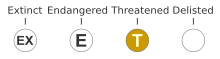
In an attempt to secure the snail's continued existence, the United States Fish and Wildlife Service added it as a threatened subspecies, to the Federal Endangered and Threatened Species List on July 3, 1978.[5] It is a Federal offense punishable by as much as a $50,000 fine and one year in jail for taking a noonday snail.