Patoleo
Indian stuffed turmeric leaf wraps
From Wikipedia, the free encyclopedia
Hindu community

Konkani-speaking Hindus prepare Patoleo on the second Sunday of Shravan,[1] on Nag Panchami and on Hartalika, the eve of Ganesh Chaturthi.[2] Salt-free Patoleo are offered to the Goddess Parvati, who, according to local legend, is said to have a strong craving for these sweets during her pregnancy.
Patoleo is traditionally served wrapped in its leaf on a dish. The leaf is removed before eating, and the sweet is commonly consumed as part of a vegetarian festive meal during Goan Hindu festivals.[3] A similar dish called Ely Ada is made in Kerala for the festival of Onam.
Christian community

The simplest version of the Goan Catholic Patoleo is prepared by smearing parboiled rice (ukadeñ tândul) paste on fresh turmeric leaves (hôldi pân) to which a filling of freshly grated coconut (chûn) and coconut jaggery (mâddâcheñ godd) is added. The leaves are then folded, sealed and steamed, traditionally in a utensil known as chondrõ. These are served hot on a platter with the leaves on and eaten after peeling them off. They are often accompanied with tea or other hot beverages.[4]
The Catholic feast of the Assumption of the Blessed Virgin Mary (a holy day of obligation) which falls on 15 August coincides with the Independence Day of India.[5] It is a feast held dearly by the Goan Catholic community, as many villages across Goa celebrate Konsâcheñ fest (harvest festival) on this day and Patoleo are the star dish of the celebration.[6][7][8] It is also prepared in Goa on the feast of São João (Nativity of St John the Baptist) which falls on 24 June.[9]
Patoleo are sent with Vojeñ (bridal trousseau) to the bridegroom's house by the Goan people;Catholics and Hindus alike. The tradition of distributing Patoleo to neighbours and friends after the arrival of a new born in the family is still retained by some Goans. In bygone times, Patoleo were also distributed to mark the completion of construction of a house in Goa. Some Goan Catholic families send Patoleo to a house where people are mourning the death of a family member.[9] Before modern medicine, Patoleo was used as a traditional remedy for whooping cough.[10]
East Indian Catholics call it Pân Mori or 'East Indian leaf cakes' and the Mangalorean Catholic community calls it Patoli (ಪಾತೊಳಿ) in Kannada.
Gallery
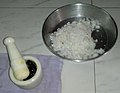 Grated coconut (soy) and palm jaggery (mâddâcheñ godd) in mortar and pestle
 Mixing soy and mâddâncheñ godd
 Parbolied (ukadeñ tândul) rice paste, jaggery-coconut mixture (chûn), and turmeric leaves (hôldi pân)
 Ukadeñ tândul paste smeared on Hôldi pân
 Chûn and rice paste smeared on turmeric leaf
 Patoli before steaming
 Patoleo before steaming
 Chondrõ steamer
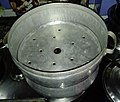 Opened chondrõ
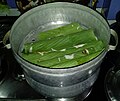 Patoleo placed for steaming
 Steamed patoleo in chondrõ
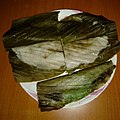 Patoleo ready to be eaten after peeling the leaves
 Unsweetened black tea and patoleo


.jpg)


