Pediastrum
From Wikipedia, the free encyclopedia


Pediastrum is a genus of green algae, in the family Hydrodictyaceae.[1] It is a photoautotrophic, nonmotile coenobial green alga that inhabits freshwater environments. The name Pediastrum comes from the Greek root words pedion, meaning "plane", and astron, meaning "star", referring to its overall shape.[2]
Pediastrum develops colonies with a fixed number of cells, termed coenobia. In this case, the coenobia are composed of between 22 and 27 cells, which are orderly arranged in a flat disk. The diameter of a single coenobium ranges from 20 to 80 μm, making them microalgae. Cells in Pediastrum are dimorphic, consisting of interior cells and peripheral cells, distinguished by their position in the colony and by their shape. Some species have inter-cellular spaces between their interior cells. The peripheral cells surround the interior cells, and they usually possess bristles, V-like cutting edges, or wavy projections.
Pediastrum shows lots of morphological diversity, both between and within species. Although most species produce flat, circular coenobia, others produce coenobia that are more oval-shaped, or curved and bowl-shaped. For species identification, the shape of the cells (particularly marginal ones), presence or absence of intercellular gaps, and ornamentation of the cell wall are all important distinguishing characteristics.[3]
Phylogeny
The genus of Pediastrum belongs to the Hydrodictyaceae family, along with Pseudopediastrum, Tetraedron, Hydrodictyon and so on. Pediastrum spp. on the phylogenetic tree can be divided into Group I, Group II, Group III.[4] Group I, which includes Pediastrum duplex, are mainly distributed in North America and Europe. Group II is mostly from Australia, containing among others P. angulosum and P. alternans. Group I, Group II form a monophyletic group (clade) in the phylogenetic tree together with Hydrodictyon spp. lastly, Group III forms a sister group with Monactinus spp.
For the morphological characteristics of these groups, Group I has intracellular spaces and V-like incisions in the cells along the outside, while some species in Group II lack intercellular spaces, and their peripheral cells are wavy. Although there are significant differences between the appearance of Pediastrum and Hydrodictyon, it is still related more closely to it than several genera that look more alike, such as Pseudopediastrum, Monactinus and Stauridium.
 Pediastrum
 Stauridium tetras
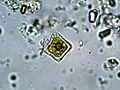 Tetraedron
 Pseudopediastrum boryanum
 Monactinus simplex
 Hydrodictyon reticulatum
 Pediastrum boryanum
 Colony of Pediastrum algae
.jpg)


Fossil record
Cell walls of Pediastrum form a "globular network" with interconnected nodes.[5] These walls are difficult to break down due to the presence of sporopollenin[3] and silica,[6] which the algae uses to defend itself against infection. This also coincidentally makes it very resistant to diagenesis. Because of this, Pediastrum is known to have existed since the Early Cretaceous.[7] In 2005, several studies on the fossil record of Pediastrum were compiled, and 10 species in the genus are now recognized between the Late Cretaceous and the Quaternary in southern South America alone.[8]
