Peeler centrifuge
From Wikipedia, the free encyclopedia
The peeler centrifuge is a device that performs by rotating filtration basket in an axis. A centrifuge follows on the principle of centrifugal force to separate solids from liquids by density difference. High rotation speed provides high centrifugal force that allows the suspended solid in feed to settle on the inner surface of basket. There are three kinds of centrifuge, horizontal, vertical peeler centrifuge and siphon peeler centrifuge. These classes of instrument apply to various areas such as fertilisers, pharmaceutical, plastics and food including artificial sweetener and modified starch.
Operation
- [1] Peeler centrifuge operates on the principle of centrifugal force to separate solids from liquids by density difference. And high rotation speed provides high centrifugal force that allows the suspended solid in feed to settle on the inner surface of drum, also washing and washing processes at the same rotational speed and in same centrifuge vessel.
- [2][3] Peeler centrifuges are batch and continuous centrifuge processes, and this process may be used to achieve maximum removal of solid from liquid that may be required to be as pure as possible and can not be easily separated by differences their densities.
Types
Horizontal peeler
- [2] The horizontal peeler centrifuge is one of oldest peeler centrifuge designs. The first horizontal peeler centrifuge was manufactured by Buffaud et Robatel (Lyon, FRANCE) in 1905 for synthetic ammonia production at plants in Europe, Russia, Japan, and the USA.
- [2][4] The horizontal peeler centrifuge has a general structure (refer to section 1.1) with horizontal rotating basket, which sits inside of external casing. The door of drum can be opened fully and contains feed; wash, feed control and solids discharge components. Modern machines are supported by cantilever for ease of access to inside of drum and components for purpose of maintenance. The unit required rugged structure, as it needs to handle high speeds of rotation and feeds, discharging capability.
- [4] The horizontal arrangement of rotating drum provides several advantages (refer to section 6.1) over other centrifuge systems, such as vertical basket centrifuge.
Vertical peeler
- [2] The vertical peeler (also known as vertical basket peeler) is a centrifuge system that has the same basic operating principles as the horizontal peeler centrifuge. The only difference other than arrangement, is that the scrapped off solids layers are not removed by chute of peeler, but it is discharged through the discharge chute at the bottom of centrifuge vessel.
- Because it does not utilise peeler action to remove solid layers, the centrifuge system must be decelerated so that the solid product can be discharged by gravity without centrifugal force that prevents solids to be dropped to discharge chute.
Siphon peeler
- [4] The siphon peeler centrifuge is another peeler centrifuge design developed by Krauss-Maffei in the 1970s. Rather than only centrifugal pressure based filtration, siphon peeler centrifuge contains perforate units both horizontally and vertically.
- Siphon peeler centrifuge has similar structure to Krauss-Maffei horizontal peeler centrifuge, except instead of inner drum wall with pores, siphon peeler centrifuge has solid inner drum wall where the liquid filtered through solid cake and filter medium will flow along the wall axially and through siphon pipe into separate chamber unlike horizontal peeler centrifuge.
- This solid wall and instant removal of filtered liquid advantage this design by providing large pressure difference across the solid cake and filter medium, so does strong driving force, which increases filtration efficiency.
Range of Applications
Horizontal peeler
- [5][6] Generally peeler centrifuges are used to separate solids, usually fine particles from suspension liquid feed mixtures. Horizontal peeler centrifuges are widely used design in separation processes in:
- Bulk chemicals such as petrochemical intermediates, fertilisers, chlorides, sulfates and calcium.
- Fine chemicals: aluminium fluoride, amino acids, bleaching agents, surfactants, pesticides, catalyst and dyestuffs.
- Pharmaceuticals
- Plastics
- Foods including artificial sweeteners, caffeine and modified starches.
Vertical peeler
- [7] Vertical peeler centrifuge applications are similar to the horizontal peeler centrifuge. The following areas are where vertical centrifuge is mainly used for processes (refer to section 3.1).
Siphon peeler
- [2] Siphon peeler centrifuge has similar applications to the horizontal peeler centrifuge (refer to section 3.1) and is very flexible in use. It is used for starch, herbicides or fine chemicals.
Main process characteristics
Main process of centrifuge
- [5] There are several steps in peeler centrifuge process:
- Feeding
- The suspension is introduced to the rotating centrifuge basket via the feed distributor to prevent from spilling over the basket rim also to ensure the even cake level. The level of the feed is monitored and regulated by a feed controller, and normally the basket is filled up to 75-80% of the basket rim height. The feed step is complete when the filter cake has reached the desired level.
- Filtration
- Primary filtration for liquid phase of the feed through the filter medium attached in the basket is proceeding until the liquid has submerged into the filter cake and drained outside the rotating basket. The solid phase is held on the filter medium and become sediment, which forms secondary filter giving extra efficiency.
- Washing
- After the filtration step, washing liquid is introduced through feed distributor and separate spray bar. Under the effect of the centrifugal force, the washing liquid submerged into cake and filter. Washing can be carried out at the same or higher speed than the feeding step.
- Dry spinning
- The fluid in filter cake is drained by accelerating basket to maximum allowable speed and kept constant. The residual cake moisture decreases over time under the constant centrifugal force and ends when it reaches the desired residual humidity.
- Discharging the solids/filter cake
- The filter cake is removed from the basket by a pivoting peeling device equipped with a broad peeling knife and scraping until a thin layer of filter cake is retained to protect the filter medium. The scraped layers of product are discharged through an inclined chute or screw conveyor.
- Cleaning centrifuge
- Cleaning of the interior of the centrifuge required after every, or several cycles to clear the solids out of holes in basket and preserve the efficiency of filtration. The inside of the centrifuge with all built in devices can be cleaned automatically with an integrated CIP (cleaning in place system) without the need to open the centrifuge.
Operational parameters
- The manufacturer can vary the operational parameters of the peeler centrifuge for specific applications. The parameters in this section are from several different peeler manufacturers.
Centrifugal force
- GMP-Compatible HZ peeler Centrifuge (HZ-Phll): 1060-2030G
- Mitsubishi/KM Siphon peeler Centrifuge (HZ-Si): 200-1895G
Rotational speed
- Horizontal peeler Centrifuges (H630P-H1250P): 1180-2400rpm
- Vertical peeler Centrifuges (V 800 – 1600 BG): 575-1000rpm
- Mitsubishi/KM Siphon peeler Centrifuge (HZ-Si): 950-3000rpm
Particle size
- Horizontal Peeler Centrifuge: 2-500 μm
- Horizontal discontinuous separation Peeler Centrifuge: 2 μm-10mm
Capacity
- Horizontal peeler centrifuges (H630P-H1250P): 42-303L
- GMP-Compatible HZ peeler Centrifuge(HZ-Phll): 11-333L
- Vertical peeler centrifuges (V 800 – 1600 BG): 160-1250L
- Mitsubishi/KM Siphon peeler Centrifuge(HZ-Si): 11-875L
Processes and Equipment Design
Design Heuristics
Horizontal discontinuous separation Peeler Centrifuge
- [8] First of all, the suspension is filled into the batch at fixed or variable speed by gravity or pump. Then the feed is controlled by filling valve and the basket is observed by filling level controller. Following step is washing solids. Using a variety of fluids, cake is washed and become intensive. After the washing step, a hydraulically powered scraper is used for removal of cake.
Vertical peeler centrifuge
- [7] At first, the suspension is filled into the vertical basket at adjusted speed. The effect of the centrifugal force make the solid particle settles on the filter fabric on the basket shell. Depending on the product, intermediate centrifuging is required and it interrupts the filling process. Also it will be repeated several times by the filtration reaction of the product. The solids in the basket are washed at the same or higher speed than the filling process after suspension has been centrifuged. And hydro-extraction stage is followed. Depending on the solids and fluids parameters, the height of the filter cake and, naturally, the centrifugal force acting upon the fluid to be separated. After the extraction, the filter cake discharged from the basket by means of a short peeling knife.
Design Equation
[4]
Centrifugal Acceleration
- (Equation 1)

- where
- is the tangential velocity at the given point on the curve trajectory
- is the radius of curvature at the point.
- Equation 1 depicts the kinematic relationship of centrifugal force required to sustain the movement of mass along a curve trajectory. The force acts perpendicularly to the direction of motion and is directed radially inward.


Solid body rotation
- When body of fluid rotates in a solid-body mode, the tangential or circumferential velocity is linearly proportional to radius.
- (Equation 2)

- where
- is the angular speed of the rotating frame
- is the radius from the axis of rotation.
- Equation 2 shows linear relationship of radius and circumferential velocity, .


Fluid Viscosity and Inertia
- (Equation 3)

- where
- is the kinematic viscosity of the liquid and Ω is the angular speed of the rotating frame
- is the thickness of the layers called ‘Ekman layers’. This layer is responsible for transfer of angular momentum between the rotating surfaces to fluid during acceleration and deceleration.
- Equation 3 shows the dynamic effect of viscosity of liquid slurry in sedimenting centrifuge is confined in very think fluid layers.


Cake dryness
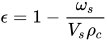
- Dewatering is important step for centrifuge filtration to ensure the quality of solid output. The dryness can be measured by cake porosity,
- (Equation 4)
- where
- is the mass of solid
- is the cake volume
- is the cake solid density.


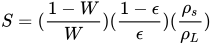
- From porosity, the content of moisture in the wet cake is measured by looking at saturation, S.
- (Equation 5)
- where
- is the weight of solid fraction
- is the liquid density.
- Equation 5 describes when saturation is less than 1, for unsaturated solid cake.
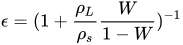
- When the solid cake is saturated, S=1 , the cake porosity can be determined by Equation 6 below
- (Equation 6)


Total solid recovery
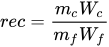
- In clarification, the total solids recovered in the solid cake measure the clarity of the effluent indirectly. This indirect relationship is shown in Equation 7,
- (Equation 7)
- where
- subscript c and f denote, the cake and feed respectively.
- denotes the bulk mass flow rate.

Critical Speed
- The critical speed is important factor to consider design. Critical speed is the speed of rotation at which the frequency of rotation matches the natural frequency. At this speed, any vibration caused by slight unbalance in the rotor is strongly reinforced, which may results high stresses or even failure of equipment.