Pentace laxiflora
From Wikipedia, the free encyclopedia
| Pentace laxiflora | |
|---|---|
Scientific classification  | |
| Kingdom: | Plantae |
| Clade: | Tracheophytes |
| Clade: | Angiosperms |
| Clade: | Eudicots |
| Clade: | Rosids |
| Order: | Malvales |
| Family: | Malvaceae |
| Genus: | Pentace |
| Species: | P. laxiflora |
| Binomial name | |
| Pentace laxiflora Merr., Philip. J. Sci. 30 (1926) | |
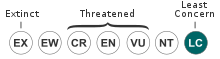
Pentace laxiflora is a species of flowering plant in the family Malvaceae sensu lato or Tiliaceae. It is a tree endemic to Borneo. Its conservation status has been listed by the International Union for Conservation of Nature as being of least concern.
Pentace laxiflora is a medium-sized tree growing to a height of about 30 m (100 ft), the trunk having a maximum diameter of 50 cm (20 in). The leaves have short stalks with a pair of small stipules at the base, and are alternate, usually hairless, lanceolate and whitish underneath. The inflorescence is a lax panicle with small, widely separated, creamy-coloured flowers, each about 7 mm (0.3 in) in diameter. The seeds are winged nuts, about 14 mm (0.6 in) in diameter.[2]
Distribution and habitat
Pentace laxiflora is endemic to Borneo where it is found in Brunei, Sabah, Sarawak and Kalimantan, its total area of occurrence being about 250,000 km2 (96,500 sq mi). It grows in mixed dipterocarp forests, both primary and secondary, at altitudes of up to 600 m (2,000 ft).[1]