Perimeter of an ellipse
From Wikipedia, the free encyclopedia
Unlike most other elementary shapes, such as the circle and square, there is no closed-form expression for the perimeter of an ellipse. Throughout history, a large number of closed-form approximations and expressions in terms of integrals or series have been given for the perimeter of an ellipse.

Exact value
Elliptic integral
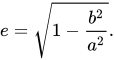
An ellipse is defined by two axes: the major axis (the longest diameter) of length and the minor axis (the shortest diameter) of length , where the quantities and are the lengths of the semi-major and semi-minor axes respectively. The exact perimeter of an ellipse is given by the integral[1]where is the eccentricity of the ellipse, defined as[2]If we define the functionknown as the complete elliptic integral of the second kind, the perimeter can be expressed in terms of that function simply asThe integral used to find the perimeter does not have a closed-form solution in terms of elementary functions.




Infinite sums
Another solution for the perimeter, this time using the sum of an infinite series, is[3]where is the eccentricity of the ellipse.

More rapid convergence may be obtained by expanding in terms of . Found by James Ivory,[4] Bessel[5] and Kummer,[6] there are several equivalent ways to write it. The most concise is in terms of the binomial coefficient with , but it may also be written in terms of the double factorial or integer binomial coefficients: The coefficients are slightly smaller (by a factor of ) than the preceding, but also is numerically much smaller than except at and . For eccentricities less than 0.5 (), the error is at the limits of double-precision floating-point after the term.[7]



Approximations
Exact evaluation of elliptic integrals may be impractical in some cases due to their computational complexity. As a result, several approximation methods have been developed over time.
Ramanujan's approximations
Indian mathematician Srinivasa Ramanujan proposed multiple approximations.[8][9]
First approximation

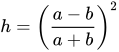
Second approximation
where .


Final approximation
The final approximation in Ramanujan's notes was an improvement on his second approximation. It is regarded as one of his most mysterious equations.where and is the eccentricity of the ellipse.[9]


Ramanujan did not provide any rationale for this formula.
 ,
,  ...
...Derivation of Ramanujan's approximations |
|---|
|
Second Approximation Ramanujan's second approximation formula follows from the series representation of the perimeter of an ellipse. The expansion of the general form,
can be compared to the first three terms of the infinite series,
to show that
Solving the system of equations, we find
Substituting the values into the original equation and simplifying algebraically yields Ramanujan's second approximation formula. This formula is accurate up to the fourth coefficient of the series expansion for the perimeter of an ellipse. Final Approximation Mathematician Mark Villarino demonstrated that each coefficient in the series representation of Ramanujan's approximation, beyond the fourth, is less than that of the exact perimeter's series representation. He also proved that the error in Ramanujan's approximation is
where is a monotonically increasing function on the interval and
[9] By taking 's lower bound, substituting for the equivalent form , and writing its truncated series representation , one can reconstruct the error correction term Ramanujan used in his final approximation:
A slightly more precise approximate form can be produced by leaving the term intact:
where . |