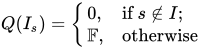
In topological data analysis, a persistence barcode, sometimes shortened to barcode, is an algebraic invariant associated with a filteredchain complex or a persistence module that characterizes the stability of topological features throughout a growing family of spaces.[1] Formally, a persistence barcode consists of a multiset of intervals in the extended real line, where the length of each interval corresponds to the lifetime of a topological feature in a filtration, usually built on a point cloud, a graph, a function, or, more generally, a simplicial complex or a chain complex. Generally, longer intervals in a barcode correspond to more robust features, whereas shorter intervals are more likely to be noise in the data. A persistence barcode is a complete invariant that captures all the topological information in a filtration.[2] In algebraic topology, the persistence barcodes were first introduced by Sergey Barannikov in 1994 as the "canonical forms" invariants[2] consisting of a multiset of line segments with ends on two parallel lines, and later, in geometry processing, by Gunnar Carlsson et al. in 2004.[3]
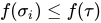
Let be a fixed field. Consider a real-valued function on a chain complex compatible with the differential, so that whenever in . Then for every the sublevel set is a subcomplex of K, and the values of on the generators in define a filtration (which is in practice always finite):
.
Then, the filtered complexes classification theorem states that for any filtered chain complex over , there exists a linear transformation that preserves the filtration and brings the filtered complex into so called canonical form, a canonically defined direct sum of filtered complexes of two types: two-dimensional complexes with trivial homology and one-dimensional complexes with trivial differential .[2] The multiset of the intervals or describing the canonical form, is called the barcode, and it is the complete invariant of the filtered chain complex.
The concept of a persistence module is intimately linked to the notion of a filtered chain complex. A persistence module indexed over consists of a family of -vector spaces and linear maps for each such that for all .[4] This construction is not specific to ; indeed, it works identically with any totally-ordered set.
A series of four nested simplicial complexes and the 0-dimensional persistence barcode of the resulting filtration.
A persistence module is said to be of finite type if it contains a finite number of unique finite-dimensional vector spaces. The latter condition is sometimes referred to as pointwise finite-dimensional.[5]
Let be an interval in . Define a persistence module via , where the linear maps are the identity map inside the interval. The module is sometimes referred to as an interval module.[6]
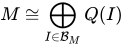
Then for any -indexed persistence module of finite type, there exists a multiset of intervals such that , where the direct sum of persistence modules is carried out index-wise. The multiset is called the barcode of , and it is unique up to a reordering of the intervals.[3]
This result was extended to the case of pointwise finite-dimensional persistence modules indexed over an arbitrary totally-ordered set by William Crawley-Boevey and Magnus Botnan in 2020,[7] building upon known results from the structure theorem for finitely generated modules over a PID, as well as the work of Cary Webb for the case of the integers.[8]
↑ Chazal, Fréderic; de Silva, Vin; Glisse, Marc; Oudot, Steve (2016). The structure and stability of persistence modules. Switzerland. ISBN978-3-319-42545-0. OCLC960458101.{{cite book}}: CS1 maint: location missing publisher (link)
↑ Botnan, Magnus, and William Crawley-Boevey. "Decomposition of persistence modules." Proceedings of the American Mathematical Society 148, no. 11 (2020): 4581-4596.




![{\displaystyle K_{a}=f^{-1}((-\infty ,a])}](https://wikimedia.org/api/rest_v1/media/math/render/svg/235fc6279bcebdc5a230c511241b068d9a9c8530)