Philippe Wolfers
From Wikipedia, the free encyclopedia
 (aged 71)
City of Brussels
Philippe Wolfers | |
|---|---|
 | |
| Born | 16 April 1858 |
| Died | 13 December 1929 (aged 71) City of Brussels |
| Alma mater | |
| Occupation | Jewelry designer, medalist, visual artist |
| Parent(s) |
|
Philippe Wolfers (16 April 1858 – 13 December 1929) was a Belgian silversmith, jeweler, sculptor, medallist[1] and designer. His mature work belongs to the Art Nouveau style, while in his later years his work aligned with Art Deco. As a jewel designer, he was less prolific than his French contemporary René Lalique. Nevertheless his "exemplaire unique" series of jewelry is among the finest jewelry created in Art Nouveau.[2] Wolfers is also known for his sculptures, decorative objects and tableware executed in precious materials such as silver, bronze, ivory and marble. He also designed vases and objects in glass and faience.
Philippe Wolfers was the son of Louis Wolfers (1820–1892) who led the family firm "Wolfers frères", silversmith and court jeweler in Brussels. The young man entered the family business as an apprentice in 1875. He studied sculpture at the Royal Academy of Fine Arts in Brussels and with Isidore De Rudder. With his father, Philippe undertook many study trips through Europe, visiting the world exhibitions in Vienna (1873) and Paris (1889). Like many of his contemporaries, he was influenced by Japanese art. Inspired by the influx of Japanese art in Europe during the 1870s, Wolfers transitioned from stiff, ornamental designs to more realistic portrayals of nature, integrating Japanese aesthetics into his work.[3]
Design director at "Wolfers frères"
After the death of his father in 1892, Philippe Wolfers, with his brothers Max and Robert, took over the family firm and became its design director. In this role, he introduced silverware in an avant-garde Art Nouveau style, such as the Orchidées ("Orchids") fruit bowl from 1894 and one of his vases from around 1896 exhibited at the Metropolitan Museum of Art in New York City.[4] During this period, he began incorporating organic materials like ivory, carnelian, opal, and tourmaline, with artisans skillfully carving these into intricate floral and animal forms, which became a signature of his unique Art Nouveau creations.[5]
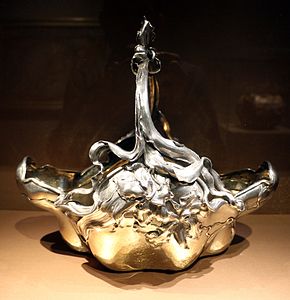 Orchidées ("Orchids") fruit bowl, silver (1894)
 Orchidée ("Orchid") flower pot, glazed earthenware (1897)


_02.jpg)

.jpg)
,_KMKG-MRAH.jpg)
