Phonological opacity
From Wikipedia, the free encyclopedia
| Part of a series on |
| Linguistics |
|---|
 Portal Portal |
Phonological opacity is a phenomenon in phonology. Opacity exists when a phonological rule that exists in a given language appears to be contradicted by the surface structure (i.e., actual pronunciation) of words in the language. Opacity is a property of a certain surface structure, rather than a specific rule. The term was first defined by Kiparsky[1] in the following way:[2]
A phonological rule P, , is opaque if one of the following surface structures exists:
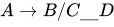
- instance of A in the environment;
- instance of B created by P in an environment other than ;

Although we sometimes talk of opaque rules, a rule by itself is not opaque, it is the interaction between two rules that creates an opaque surface form (i.e., it becomes difficult to understand which rules were applied and how these rules interacted).
Example Rules
Traditionally, there are four recognized, pairwise ordered, rule relations in rule-based serialism:[2]
Given two rules A, B such that A precedes B,
- A feeds B iff A creates additional inputs to B
- A bleeds B iff A eliminates potential inputs to B
- B counterfeeds A iff B creates additional inputs to A
- B counterbleeds A iff B eliminates potential inputs to A
For the purpose of eliciting each rule interaction in the classic model, we'll use two example rules.
Rule A is a Deletion rule, where a vowel ( V ) is deleted ( Ø ) when it precedes another vowel ( __ V ). We represent this rule as V → Ø / __ V.
Rule B is a Palatalization rule, where a voiceless stop /t/ palatalizes to the affricate [tʃ] when preceding /e/ ( __ e ). We represent this rule as t → tʃ / __ e.
Feeding
Rule A feeds B when it occurs before B and helps B to apply. This can happen either because A creates an output that is the input for B; or A creates an output that is an environment where B can occur.
In a hypothetical language with a word like /tue/, if Deletion occurs first it is said to feed Palatalization. Through the deletion of the vowel [u] (because it precedes another vowel [e]), Deletion has created an environment where Palatalization can occur, palatalizing [t] to [tʃ]. We derive [tʃe] from /tue/.
| /tue/ | ||
| Deletion: | V → Ø / __ V | Ø |
| Palatalization: | t → tʃ / __ e | tʃ |
| [tʃe] | ||
This type of rule ordering is said to be transparent, because the surface form seems to be following all rules of the language. In fact, if we look at the surface form [tʃe], we see a [tʃ] segment preceding an [e] segment. In other words, palatalization has correctly applied. The fact that /u/ was deleted and that we derived [tʃ] from /t/ is irrelevant in our assessment of whether this surface form is transparent or opaque.
Bleeding
Rule A bleeds B when it occurs before B and hinders B from applying. This can happen either because A and B have the same input but A gets to it first; or if the input for A is the environment where B could've occurred.
In the case of /teo/, Palatalization would've occurred if it preceded Deletion. However, since Deletion occurs before, it removes the environment where Palatalization would've occurred. We derive [to] from /teo/.
| /teo/ | ||
| Deletion: | V → Ø / __ V | Ø |
| Palatalization: | t → tʃ / __ e | |
| [to] | ||
This type of rule ordering is said to be transparent, because the surface form seems to be following all rules of the language. In fact, if we look at the surface form [to], we see a [t] segment preceding an [o] segment. No rules of this hypothetical language seem to be violated. The fact that /e/ was deleted and that we weren't able to derive [tʃ] from /t/ because of this deletion is irrelevant in our assessment of whether this surface form is transparent or opaque.
Counterfeeding
Rule A counterfeeds B when it occurs before B and helps B to apply. Additionally, rule B would've fed rule A if it preceded it, however it didn't. Counterfeeding can be seen as the reverse rule ordering of feeding.
If we look back at /tue/, in this example Palatalization precedes Deletion. However, Palatalization can't occur because there is no relevant environment for it (namely, /t/ isn't preceding /e/ yet). Then, Deletion of /u/ occurs, making /t/ and /e/ adjacent. Deletion occurs too late for Palatalization to do anything about it. We derive [te] from /tue/.
| /tue/ | ||
| Palatalization: | t → tʃ / __ e | |
| Deletion: | V → Ø / __ V | Ø |
| [te] | ||
This type of rule ordering is said to be opaque, because the surface form seems to have an environment where a rule of the language could still apply. In fact, if we look at the surface form [te], we see a [t] segment preceding an [e] segment. We know that we have a palatalization rule, and it seems like it hasn't applied here, i.e. it seems like it has underapplied.
Note that no rule has actually underapplied, it only appears as if it did. If there actually is underapplication of a rule in a dataset, there's a problem with the rule. In the case of counterfeeding, all rules have applied correctly, but their ordering makes it appear like it didn't. Thus, this surface form is opaque.
Counterbleeding
Rule A counterbleeds B when it occurs before B and hinders B from applying. Additionally, rule B would've bled rule A if it preceded it, however it didn't. Counterbleeding can be seen as the reverse rule ordering of bleeding.
If we look back at /teo/, where Palatalization precedes Deletion, /t/ precedes /e/, therefore palatalizes into /tʃ/. /e/ precedes /o/, allowing for Deletion to occur. Palatalization doesn't hinder Deletion, so when Deletion occurs, it removes any evidence of the Palatalization environment. We derive [tʃo] from /teo/.
| /teo/ | ||
| Palatalization: | t → tʃ / __ e | tʃ |
| Deletion: | V → Ø / __ V | Ø |
| [tʃo] | ||
This type of rule ordering is said to be opaque, because the surface form seems to have an environment where a rule of the language shouldn't have applied. In fact, if we look at the surface form [tʃo], we see a [tʃ] segment preceding an [o] segment. We know that we have a palatalization rule, but this rule only applies when /t/ precedes /e/, but not /o/; i.e. it seems like it has overapplied.
Note that no rule has actually overapplied, it only appears as if it did. If there actually is overapplication of a rule in a dataset, there's a problem with the rule. In the case of counterbleeding, all rules have applied correctly, but their ordering makes it appear like it didn't. Thus, this surface form is opaque.
Focus vs. Environment
Sometimes a distinction is made between counterfeeding/counterbleeding on focus and counterfeeding/counterbleeding on environment, which specifies the position of the interaction.
Counterfeeding on focus means that rule B would've fed rule A, and would've done so by having an output that is rule A's input:
| /ata/ | ||
| Rule A: | d → ð / __ V | |
| Rule B: | t → d / V __ | |
| [ada] | ||
Counterbleeding on focus means that rule B would've bled rule A, and would've done so by having an input that is rule A's input.
| /at/ | ||
| Rule A: | t → d / V __ | |
| Rule B: | t → s / __ # | |
| [ad] | ||
Counterfeeding on environment means that rule B would've fed rule A, and would've done so by having an output that is rule A's environment which would have allowed rule A to apply:
| /sen/ | ||
| Rule A: | s → ʃ / __ i | |
| Rule B: | e → i / __ n | |
| [sin] | ||
Counterbleeding on environment means that rule B would've fed rule A, and would've done so by having an input that is rule A's environment which would not have allowed rule A to apply:
| /anpa/ | ||
| Rule A: | n → m / __ p | |
| Rule B: | p → f / __ V | |
| [amfa] | ||
Hypothesized Consequences of Opacity
Learnability
Opacity is said to affect the learnability of certain forms during a child's acquisition of language. Namely, a child will have a harder time acquiring these opaque forms, because they are not predicted by the rules of its language, rules that it either is in the process of acquiring, or has fully acquired. Some research suggests that transparent rule orderings (i.e., feeding and bleeding) result in better acquisition, while opaque forms are harder to learn.[3][2] This is intuitive and follows what is called the transparency bias. However, further research shows that there is also a maximum utilization bias, where forms that have both rules apply (i.e., feeding and counterbleeding) are acquired easier than those that apply only once (bleeding and counterfeeding).[3] This bias varies with the types of rules that are applied, where generally speaking, the patterns are predicted by the transparency bias, while patterns involving palatalization processes tend to be predicted with the MaxUtil bias.[3] Deletion seems to favor counterfeeding over counterbleeding, which isn't predicted by any of the aforementioned biases, but other experiment-specific factors for this pattern might be involved, such as the choice of stimuli given to participants.[3]
Opacity as a Discrepancy
In many instances, the presence of opacity in an analysis can indicate that something has gone awry. It can often suggest that the framework used to analyze the data is flawed or unsuitable, and that a different framework is required to better explain a process. This is famously made evident with the Duke of York derivation.[4][2]
The Grand Old Duke of York
He had ten thousand men
He marched them up a great high hill
And he marched them down again.
Duke of York derivations are described to be similar to the little nursery rhyme that accompanies its name: a certain process turns A into B, and then another process turns B back into A, seemingly achieving nothing. Duke of York derivations are not really interesting, except that they sometimes indicate that something is wrong in our own analysis. Some argue that DOY derivations are unnatural and difficult to learn. DOY derivations are more common in syntax, where one process can often undo another one.
Another example for opacity as an indicator for framework issue is the nasalization process in Bulgarian. If we analyze this process using a rule-based framework, it seems at first that there is opacity. Despite being underlyingly voiced, /n/ doesn’t devoice word-finally like other consonants in Bulgarian. Instead, when a word with a final /n/ is suffixed, the previous vowel becomes nasalized and the /n/ is deleted:
| кон | /kɔn/ → [kɔn] | “horse” |
| конски | /kɔnski/ → [kɔ̃ski] | “of horse type” |
| тон | /tɔn/ → [tɔn] | “tone” |
| тонколона | /tɔnkɔlɔna/ → [tɔ̃kulɔna] | “speaker” (literally “tone-column”) |
These processes can be formalized using the following rules:
| /kɔnski/ | ||
| Nasalization: | V → [+nasal] / __nC | ɔ̃ |
| N-Elision: | n → ∅ / __C | ∅ |
| [kɔ̃ski] | ||
Ordered in the above way, Nasalization appears to have overapplied. N-Elision counterbleeds Nasalization i.e., it removes the environment required for Nasalization to apply, so on the surface it appears as if Nasalization applies when it shouldn’t. This is counterbleeding opacity.
Opacity in this case arises from the analytical framework itself. However, analyzing this phenomenon using an autosegmental phonology framework may provide a better, simpler, and more parsimonious explanation for this process, without running into the issue of opacity. The Laryngeal node delinks because it isn't licensed (the following segment is not a sonorant). The nasal segment deletes, but the Supra-Laryngeal node remains, and the nasal feature with it. The nasal feature then spread to the preceding vowel, nasalizing it.
![From left to right: Laryngeal node delinks because it is not licensed (isn't followed by an obstruent). The nasal deletes, but the SL node remains, and the [nas] feature with it. [nas] spreads to the vowel, making it nasalized.](#/media/File:LaryngealNeutralizationNasalsBulgarian.png)
This gives a better explanation for the derivation of [kɔ̃ski], without running into the issues of opacity.