Pigment Yellow 10
From Wikipedia, the free encyclopedia
 | |
| Names | |
|---|---|
| IUPAC name
4-[(2,5-dichlorophenyl)diazenyl]-5-methyl-2-phenyl-4H-pyrazol-3-one | |
| Other names
Benzidine Yellow 10G, Sanyo Pigment Yellow 8105 | |
| Identifiers | |
3D model (JSmol) |
|
| ChemSpider | |
| ECHA InfoCard | 100.026.401 |
PubChem CID |
|
| UNII | |
CompTox Dashboard (EPA) |
|
| |
| |
| Properties | |
| C16H12Cl2N4O | |
| Molar mass | 347.20 g·mol−1 |
| Appearance | Yellow solid |
Except where otherwise noted, data are given for materials in their standard state (at 25 °C [77 °F], 100 kPa).
| |


Pigment Yellow 10 is an organic compound that is classified as a monoazopyrazolone pigment. It is used as a yellow colorant, notably as yellow road marking on highways in the US.
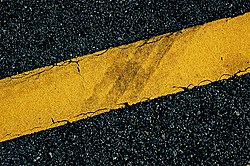
Pigment Yellow 10 is commonly used for yellow road markings

The compound is synthesized by coupling the diazonium salt derived from dichloroaniline with the pyrazolone.[1] The structure of the dye, as determined by X-ray crystallography, consists of planar molecule with a C=O bond and two hydrazone groups.[2]