Place Farm, Tisbury
From Wikipedia, the free encyclopedia
| Place Farm | |
|---|---|
 "One of the finest surviving groups of monastic grange buildings in England" | |
| Type | Farm |
| Location | Tisbury, Wiltshire |
| Coordinates | 51°04′04″N 2°04′16″W / 51.0678°N 2.0712°W |
| Built | 14th century and after |
| Governing body | Fonthill Estate |
Listed Building – Grade I | |
| Official name | Place Farmhouse |
| Designated | 6 January 1966 |
| Reference no. | 1184177 |
Listed Building – Grade I | |
| Official name | Inner gatehouse at Place Farm |
| Designated | 6 January 1966 |
| Reference no. | 1146019 |
Listed Building – Grade I | |
| Official name | Outer gatehouse at Place Farm |
| Designated | 6 January 1966 |
| Reference no. | 1300237 |
Listed Building – Grade I | |
| Official name | Tithe barn at Place Farm |
| Designated | 6 January 1966 |
| Reference no. | 1318824 |
Listed Building – Grade II | |
| Official name | Farm buildings at Place Farm |
| Designated | 6 January 1966 |
| Reference no. | 1146020 |
  Location of Place Farm in Wiltshire | |
Place Farm is a complex of medieval buildings in the village of Tisbury, Wiltshire, England. They originally formed a grange of Shaftesbury Abbey. The farmhouse, the inner and outer gatehouses and the barn, reputedly the largest in England, are all Grade I listed buildings.
Shaftesbury Abbey was founded by Alfred the Great in 888. The first religious foundation established for women in England, Alfred's daughter, Æthelgifu was installed as abbess.[1] By the Middle Ages, the abbey had become a very wealthy institution, and it established the grange at Place Farm as the administrative centre of its Wiltshire estates.[a][2] Nikolaus Pevsner, in his Wiltshire Pevsner, dates the buildings at Place Farm to the 14th and 15th centuries.[3] Anthony Quiney describes the "magnificent scale" of the complex.[4] The Victoria County History notes that the ancillary features included two chapels, two larder houses, stables, houses for oxen, hay, and charcoal, and a number of fishponds.[5] Margaret Wood, in her history, The Medieval English House, wrote that although the gatehouses are not properly defensive in a military sense, they would provide protection "against bands of marauders or discontented peasantry".[6] At the Dissolution of the Monasteries in 1536 Place Farm passed into private ownership. In the 19th century, the farm became part of the Fonthill estate of the Morrison family, who continue in ownership.[7] The tithe barn is let to Messum's, the art dealers,[8] while other farm buildings are occupied by the charity, International Cat Care.[9]
The farm house at Place Farm is a Grade I listed building. Dating mainly from the 15th century, it was renovated in the 19th. It is constructed of rubble stone, with a tiled roof. A room in the house has a frieze which carries the initials AM, that probably reference the collector Alfred Morrison who owned the estate in the 19th century.[10] The estate buildings which form three sides of a courtyard are listed Grade II.[11] The tithe barn, which at 200ft long is reputed to be the largest barn in England,[3][12] has a Grade I listing.[13] The barn was originally tiled, but now has a thatched roof,[b] which was renewed in 1971.[3] The barn is thirteen bays long, with a cruck truss roof structure.[13] The inner and outer gatehouses are also listed at Grade I.[14][15] Historic England considers the complex at Place Farm, "one of the finest surviving groups of monastic grange buildings in England".[13]
Gallery
 Outer gatehouse
 Inner gatehouse, to the left, and farmhouse
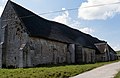 Tithe barn
 Tithe barn (long view)


