Planigon
From Wikipedia, the free encyclopedia

In geometry, a planigon is a convex polygon that can fill the plane with only copies of itself (isotopic to the fundamental units of monohedral tessellations). In the Euclidean plane there are 3 regular planigons; equilateral triangle, squares, and regular hexagons; and 8 semiregular planigons; and 4 demiregular planigons which can tile the plane only with other planigons.
All angles of a planigon are whole divisors of 360°. Tilings are made by edge-to-edge connections by perpendicular bisectors of the edges of the original uniform lattice, or centroids along common edges (they coincide).
Tilings made from planigons can be seen as dual tilings to the regular, semiregular, and demiregular tilings of the plane by regular polygons.
In the 1987 book, Tilings and patterns, Branko Grünbaum calls the vertex-uniform tilings Archimedean in parallel to the Archimedean solids. Their dual tilings are called Laves tilings in honor of crystallographer Fritz Laves.[1][2] They're also called Shubnikov–Laves tilings after Shubnikov, Alekseĭ Vasilʹevich.[3] John Conway calls the uniform duals Catalan tilings, in parallel to the Catalan solid polyhedra.
The Laves tilings have vertices at the centers of the regular polygons, and edges connecting centers of regular polygons that share an edge. The tiles of the Laves tilings are called planigons. This includes the 3 regular tiles (triangle, square and hexagon) and 8 irregular ones.[4] Each vertex has edges evenly spaced around it. Three dimensional analogues of the planigons are called stereohedrons.
These tilings are listed by their face configuration, the number of faces at each vertex of a face. For example V4.8.8 (or V4.82) means isosceles triangle tiles with one corner with four triangles, and two corners containing eight triangles.
Construction
The Conway operation of dual interchanges faces and vertices. In Archimedean solids and k-uniform tilings alike, the new vertex coincides with the center of each regular face, or the centroid. In the Euclidean (plane) case; in order to make new faces around each original vertex, the centroids must be connected by new edges, each of which must intersect exactly one of the original edges. Since regular polygons have dihedral symmetry, we see that these new centroid-centroid edges must be perpendicular bisectors of the common original edges (e.g. the centroid lies on all edge perpendicular bisectors of a regular polygon). Thus, the edges of k-dual uniform tilings coincide with centroid-to-edge-midpoint line segments of all regular polygons in the k-uniform tilings.
| Centroid-to-Centroid | 12-5 Dodecagram |
|---|---|
 |
 |
Using the 12-5 Dodecagram (Above)
All 14 uniform usable regular vertex planigons also hail[5] from the 6-5 dodecagram (where each segment subtends radians, or 150 degrees).

The incircle of this dodecagram demonstrates that all the 14 VRPs are cocyclic, as alternatively shown by circle packings. The ratio of the incircle to the circumcircle is:

and the convex hull is precisely the regular dodecagons in the k-uniform tiling. The equilateral triangle, square, regular hexagon, and regular dodecagon; are shown above with the VRPs.
In fact, any group of planigons can be constructed from the edges of a polygram, where and is the number of sides in the RP adjacent to each involved vertex figure. This is because the circumradius of any regular -gon (from the vertex to the centroid) is the same as the distance from the center of the polygram to its line segments which intersect at the angle , since all polygrams admit incircles of inradii tangent to all its sides.




Regular Vertices
In Tilings and Patterns, Grünbaum also constructed the Laves tilings using monohedral tiles with regular vertices. A vertex is regular if all angles emanating from it are equal. In other words:[1]
- All vertices are regular,
- All Laves planigons are congruent.
In this way, all Laves tilings are unique except for the square tiling (1 degree of freedom), barn pentagonal tiling (1 degree of freedom), and hexagonal tiling (2 degrees of freedom):
| Square | Barn Pentagon | Hexagon |
|---|---|---|
 |
 |
 |
When applied to higher dual co-uniform tilings, all dual coregular planigons can be distorted except for the triangles (AAA similarity), with examples below:
 S2TCH |
 I2RFH |
 IrDC |
_Non-Canonical_Tiling.svg) FH (p6) |
_Non-Canonical_Tiling.svg) sBH (short) |
_Non-Canonical_Tiling.svg) CB (pgg) |
Derivation of all possible planigons
For edge-to-edge Euclidean tilings, the interior angles of the convex polygons meeting at a vertex must add to 360 degrees. A regular n-gon has internal angle degrees. There are seventeen combinations of regular polygons whose internal angles add up to 360 degrees, each being referred to as a species of vertex; in four cases there are two distinct cyclic orders of the polygons, yielding twenty-one types of vertex.
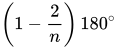
In fact, with the vertex (interior) angles , we can find all combinations of admissible corner angles according to the following rules:

- Every vertex has at least degree 3 (a degree-2 vertex must have two straight angles or one reflex angle);
- If the vertex has degree , the smallest polygon vertex angles sum to over ;
- The vertex angles add to , and must be angles of regular polygons of positive integer sides (of the sequence ).


Using the rules generates the list below:

| Degree-6 vertex | Degree-5 vertex | Degree-4 vertex | Degree-3 vertex |
|---|---|---|---|
| * | |||



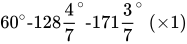













*The cannot coexist with any other vertex types.
The solution to Challenge Problem 9.46, Geometry (Rusczyk),[6] is in the Degree 3 Vertex column above. A triangle with a hendecagon (11-gon) yields a 13.2-gon, a square with a heptagon (7-gon) yields a 9.3333-gon, and a pentagon with a hexagon yields a 7.5-gon). Hence there are combinations of regular polygons which meet at a vertex.

Planigons in the plane
Only eleven of these angle combinations can occur in a Laves Tiling of planigons.
In particular, if three polygons meet at a vertex and one has an odd number of sides, the other two polygons must be the same. If they are not, they would have to alternate around the first polygon, which is impossible if its number of sides is odd. By that restriction these six cannot appear in any k-dual-uniform tiling:

On the other hand, these four can be used in k-dual-uniform tilings:

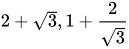
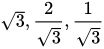
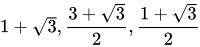
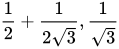
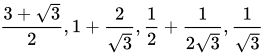
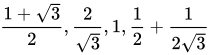
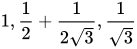
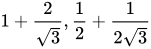
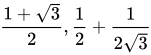
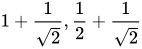
Finally, assuming unit side length, all regular polygons and usable planigons have side-lengths and areas as shown below in the table:
 | |||||||
|---|---|---|---|---|---|---|---|
| Regular Polygons | Planigons | ||||||
| Triangle | Area:
Side Lengths: 1 |
V3.122 (O) |
Area:
Side Lengths: |
V32.62 (I) |
Area:
Side Lengths: |
V44 (s) |
Area: 1
Side Lengths: 1 |
| Square | Area: 1
Side Lengths: 1 |
V4.6.12 (3) |
Area:
Side Lengths: |
V(3.6)2 (R) |
Area:
Side Lengths: |
V32.4.3.4 (C) |
Area:
Side Lengths: |
| Hexagon | Area:
Side Lengths: 1 |
V32.4.12 (S) |
Area:
Side Lengths: |
V3.42.6 (r) |
Area:
Side Lengths: |
V33.42 (B) |
Area:
Side Lengths: |
| Octagon | Area:
Side Lengths: 1 |
V3.4.3.12 (T) |
Area:
Side Lengths: |
V3.4.6.4 (D) |
Area:
Side Lengths: |
V36 (H) |
Area:
Side Lengths: |
| Dodecagon | Area:
Side Lengths: 1 |
V63 (E) |
Area:
Side Lengths: |
V34.6 (F) |
Area:
Side Lengths: |
V4.82 (i) |
Area:
Side Lengths: |











Number of Dual Uniform Tilings
Every dual uniform tiling is in a 1:1 correspondence with the corresponding uniform tiling, by construction of the planigons above and superimposition.
| m-Catalaves | ||||||||
|---|---|---|---|---|---|---|---|---|
| 1 | 2 | 3 | 4 | 5 | 6 | Total | ||
| k-dual-uniform | 1 | 11 | 11 | |||||
| 2 | 0 | 20 | 20 | |||||
| 3 | 0 | 22 | 39 | 61 | ||||
| 4 | 0 | 33 | 85 | 33 | 151 | |||
| 5 | 0 | 74 | 149 | 94 | 15 | 332 | ||
| 6 | 0 | 100 | 284 | 187 | 92 | 10 | 673 | |
| Total | 11 | ∞ | ∞ | ∞ | ∞ | ∞ | ∞ | |
Such periodic tilings may be classified by the number of orbits of vertices, edges and tiles. If there are k orbits of planigons, a tiling is known as k-dual-uniform or k-isohedral; if there are t orbits of dual vertices, as t-isogonal; if there are e orbits of edges, as e-isotoxal.
k-dual-uniform tilings with the same vertex faces can be further identified by their wallpaper group symmetry, which is identical to that of the corresponding k-uniform tiling.
1-dual-uniform tilings include 3 regular tilings, and 8 Laves tilings, with 2 or more types of regular degree vertices. There are 20 2-dual-uniform tilings, 61 3-dual-uniform tilings, 151 4-dual-uniform tilings, 332 5-dual-uniform tilings and 673 6--dualuniform tilings. Each can be grouped by the number m of distinct vertex figures, which are also called m-Archimedean tilings.[8]
Finally, if the number of types of planigons is the same as the uniformity (m = k below), then the tiling is said to be dual Krotenheerdt. In general, the uniformity is greater than or equal to the number of types of vertices (m ≥ k), as different types of planigons necessarily have different orbits, but not vice versa. Setting m = n = k, there are 11 such dual tilings for n = 1; 20 such dual tilings for n = 2; 39 such dual tilings for n = 3; 33 such dual tilings for n = 4; 15 such dual tilings for n = 5; 10 such dual tilings for n = 6; and 7 such dual tilings for n = 7.
Regular and Laves tilings
The 3 regular and 8 semiregular Laves tilings are shown, with planigons colored according to area as in the construction:

Higher Dual Uniform Tilings
Insets of Dual Planigons into Higher Degree Vertices

- A degree-six vertex can be replaced by a center regular hexagon and six edges emanating thereof;
- A degree-twelve vertex can be replaced by six deltoids (a center deltoidal hexagon) and twelve edges emanating thereof;
- A degree-twelve vertex can be replaced by six Cairo pentagons, a center hexagon, and twelve edges emanating thereof (by dissecting the degree-6 vertex in the center of the previous example).
 | ||||
|---|---|---|---|---|
 |
 |
 |
 |
 |
| Minor | Major | Full | Substitutions | |
| Dual Processes (Insets) | ||||
This is done above for the dual of the 3-4-6-12 tiling. The corresponding uniform process is dissection, and is shown here.
2-Dual-Uniform
There are 20 tilings made from 2 types of planigons, the dual of 2-uniform tilings (Krotenheerdt Duals):

3-Dual-Uniform
There are 39 tilings made from 3 types of planigons (Krotenheerdt Duals):

4-Dual-Uniform
There are 33 tilings made from 4 types of planigons (Krotenheerdt Duals):

5-Dual-Uniform
There are 15 5-uniform dual tilings with 5 unique planigons:

Krotenheerdt duals with six planigons
There are 10 6-uniform dual tilings with 6 unique planigons:

Krotenheerdt duals with seven planigons
There are 7 7-uniform dual tilings with 7 unique planigons:

The last two dual uniform-7 tilings have the same vertex types, even though they look nothing alike.
From onward, there are no uniform n tilings with n vertex types, or no uniform n duals with n distinct (semi)planigons.[9]




.gif)


.gif)


.gif)
.png)
.gif)
.png)