Pleiospilos bolusii
From Wikipedia, the free encyclopedia
| Pleiospilos bolusii | |
|---|---|
 | |
| Orto Botanico dell'Università di Genova | |
Scientific classification  | |
| Kingdom: | Plantae |
| Clade: | Tracheophytes |
| Clade: | Angiosperms |
| Clade: | Eudicots |
| Order: | Caryophyllales |
| Family: | Aizoaceae |
| Genus: | Pleiospilos |
| Species: | P. bolusii |
| Binomial name | |
| Pleiospilos bolusii | |
| Synonyms | |
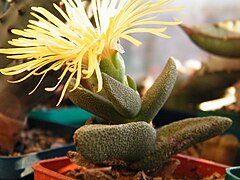
Pleiospilos bolusii, the mimicry plant,[1] is a species of flowering plant in the family Aizoaceae, native to the Eastern Cape province of South Africa, where it grows at an elevation of 750–1,100 m (2,461–3,609 ft). The species epithet bolusii honours Harry Bolus, a 19th-century South African botanist.
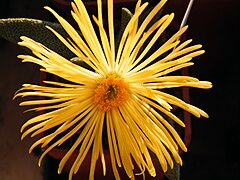
It is a small, stemless succulent perennial growing to 8 cm (3 in) tall by 15 cm (6 in) wide, with two or four opposite grey-green leaves, quite thick, fused at the base, almost triangular, with entire margins. The leaves are longer and more angular than those of the closely related P. nelii,[2] but in both cases the shape and texture of the leaves resemble a pile of split pebbles, possibly to deter predators. The yellow, many-petaled, daisy-like flowers emerge from the center of the leaves, and are 6–8 cm (2–3 in) in diameter - large in relation to the overall size of the plant. The flowers are often coconut-scented.[3] The flowering period extends from August to September.
The plant is one of several species cultivated for their rocklike appearance, which are sometimes collectively called mesembs. With a minimum temperature of 7 °C (45 °F), in temperate regions it is grown under glass. It has gained the Royal Horticultural Society's Award of Garden Merit.[1][4]
 With Lithops hookerii


