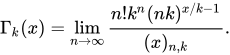
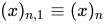
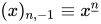
Jacobi-type J-fractions for the ordinary generating function of the Pochhammer k-symbol, denoted in slightly different notation by  for fixed
  and some indeterminate parameter
  , are considered in [2]
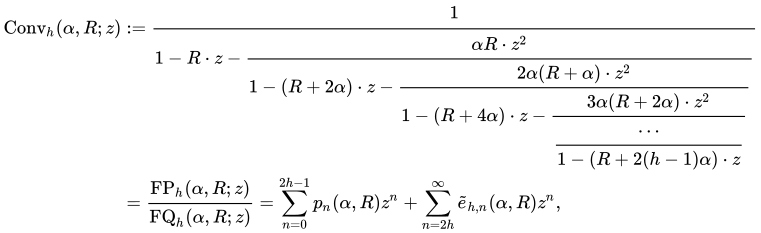
in the form of the next infinite continued fraction expansion given by
, are considered in [2]
in the form of the next infinite continued fraction expansion given by
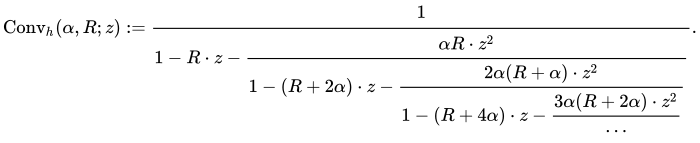
The rational  convergent function,
  , to the full generating function for these products expanded by the last equation is given by
where the component convergent function sequences, 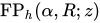 and
and 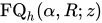 , are given as closed-form sums in terms of the ordinary Pochhammer symbol and the Laguerre polynomials by
^{n}\\{\text{FQ}}_{h}(\alpha ,R;z)&=\sum _{i=0}^{h}{\binom {h}{i}}(R/\alpha +h-i)_{i}(-\alpha z)^{i}\\&=(-\alpha z)^{h}\cdot h!\cdot L_{h}^{(R/\alpha -1)}\left((\alpha z)^{-1}\right).\end{aligned}}}](https://wikimedia.org/api/rest_v1/media/math/render/svg/6663f9246a997e99a381a5d68b11afea1d3b9ee2)
The rationality of the convergent functions for all  , combined with known enumerative properties of the J-fraction expansions, imply the following finite difference equations both exactly generating
  for all
  , and generating the symbol modulo
  for some fixed integer
  :
:

The rationality of also implies the next exact expansions of these products given by
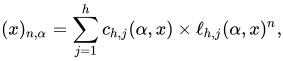
where the formula is expanded in terms of the special zeros of the Laguerre polynomials, or equivalently, of the confluent hypergeometric function, defined as the finite (ordered) set

and where  denotes the partial fraction decomposition of the rational convergent function.
Additionally, since the denominator convergent functions, , are expanded exactly through the Laguerre polynomials as above, we can exactly generate the Pochhammer k-symbol as the series coefficients
![{\displaystyle (x)_{n,\alpha }=\alpha ^{n}\cdot [w^{n}]\left(\sum _{i=0}^{n+n_{0}-1}{\binom {{\frac {x}{\alpha }}+i-1}{i}}\times {\frac {(-1/w)}{(i+1)L_{i}^{(x/\alpha -1)}(1/w)L_{i+1}^{(x/\alpha -1)}(1/w)}}\right),}](https://wikimedia.org/api/rest_v1/media/math/render/svg/71dff7accc51d7ac45872cf73736486042e9106f)
for any prescribed integer  .
.