Poly-Bernoulli number
Integer sequence
From Wikipedia, the free encyclopedia
In mathematics, poly-Bernoulli numbers, denoted as is an integer sequence. [1]

Definition
It was defined by Kaneko as:
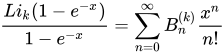
where Li is the polylogarithm. The are the usual Bernoulli numbers.

Moreover, the Generalization of Poly-Bernoulli numbers with a,b,c parameters defined as follows

where Li is the polylogarithm.
Combinatorial interpretation
Kaneko also gave two combinatorial formulas:


where is the number of ways to partition a size set into non-empty subsets (the Stirling number of the second kind).


A combinatorial interpretation is that the poly-Bernoulli numbers of negative index enumerate the set of by (0,1)-matrices uniquely reconstructible from their row and column sums. Also it is the number of open tours by a biased rook on a board (see A329718 for definition).

The Poly-Bernoulli number satisfies the following asymptotic:[2]


For a positive integer n and a prime number p, the poly-Bernoulli numbers satisfy

which can be seen as an analog of Fermat's little theorem. Further, the equation

has no solution for integers x, y, z, n > 2; an analog of Fermat's Last Theorem. Moreover, there is an analogue of Poly-Bernoulli numbers (like Bernoulli numbers and Euler numbers) which is known as Poly-Euler numbers.