Polydivisible number
Number whose first n digits is a multiple of n
From Wikipedia, the free encyclopedia
In mathematics a polydivisible number (or magic number) is a number in a given number base with digits abcde... that has the following properties:[1]
- Its first digit a is not 0.
- The number formed by its first two digits ab is a multiple of 2.
- The number formed by its first three digits abc is a multiple of 3.
- The number formed by its first four digits abcd is a multiple of 4.
- etc.
Definition
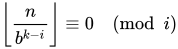
Let be a positive integer, and let be the number of digits in n written in base b. The number n is a polydivisible number if for all ,



- .
- Example
For example, 10801 is a seven-digit polydivisible number in base 4, as







Enumeration
For any given base , there are only a finite number of polydivisible numbers.

Maximum polydivisible number
The following table lists maximum polydivisible numbers for some bases b, where A−Z represent digit values 10 to 35.
Estimate for Fb(n) and Σ(b)


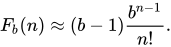
Let be the number of digits. The function determines the number of polydivisible numbers that has digits in base , and the function is the total number of polydivisible numbers in base .


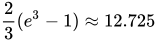
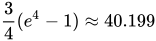
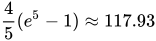
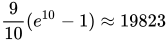
If is a polydivisible number in base with digits, then it can be extended to create a polydivisible number with digits if there is a number between and that is divisible by . If is less or equal to , then it is always possible to extend an digit polydivisible number to an -digit polydivisible number in this way, and indeed there may be more than one possible extension. If is greater than , it is not always possible to extend a polydivisible number in this way, and as becomes larger, the chances of being able to extend a given polydivisible number become smaller. On average, each polydivisible number with digits can be extended to a polydivisible number with digits in different ways. This leads to the following estimate for :


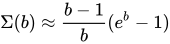
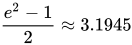
Summing over all values of n, this estimate suggests that the total number of polydivisible numbers will be approximately
Specific bases
All numbers are represented in base , using A−Z to represent digit values 10 to 35.
Base 2
 ...
...| Length n | F2(n) | Est. of F2(n) | Polydivisible numbers |
|---|---|---|---|
| 1 | 1 | 1 | 1 |
| 2 | 1 | 1 | 10 |
| 3 | 0 | 1 | |
Base 3
...| Length n | F3(n) | Est. of F3(n) | Polydivisible numbers |
|---|---|---|---|
| 1 | 2 | 2 | 1, 2 |
| 2 | 3 | 3 | 11, 20, 22 |
| 3 | 3 | 3 | 110, 200, 220 |
| 4 | 3 | 2 | 1100, 2002, 2200 |
| 5 | 2 | 1 | 11002, 20022 |
| 6 | 2 | 1 | 110020, 200220 |
| 7 | 0 | 0 | |
Base 4
...| Length n | F4(n) | Est. of F4(n) | Polydivisible numbers |
|---|---|---|---|
| 1 | 3 | 3 | 1, 2, 3 |
| 2 | 6 | 6 | 10, 12, 20, 22, 30, 32 |
| 3 | 8 | 8 | 102, 120, 123, 201, 222, 300, 303, 321 |
| 4 | 8 | 8 | 1020, 1200, 1230, 2010, 2220, 3000, 3030, 3210 |
| 5 | 7 | 6 | 10202, 12001, 12303, 20102, 22203, 30002, 32103 |
| 6 | 4 | 4 | 120012, 123030, 222030, 321030 |
| 7 | 1 | 2 | 2220301 |
| 8 | 0 | 1 | |
Base 5
The polydivisible numbers in base 5 are
- 1, 2, 3, 4, 11, 13, 20, 22, 24, 31, 33, 40, 42, 44, 110, 113, 132, 201, 204, 220, 223, 242, 311, 314, 330, 333, 402, 421, 424, 440, 443, 1102, 1133, 1322, 2011, 2042, 2200, 2204, 2231, 2420, 2424, 3113, 3140, 3144, 3302, 3333, 4022, 4211, 4242, 4400, 4404, 4431, 11020, 11330, 13220, 20110, 20420, 22000, 22040, 22310, 24200, 24240, 31130, 31400, 31440, 33020, 33330, 40220, 42110, 42420, 44000, 44040, 44310, 110204, 113300, 132204, 201102, 204204, 220000, 220402, 223102, 242000, 242402, 311300, 314000, 314402, 330204, 333300, 402204, 421102, 424204, 440000, 440402, 443102, 1133000, 1322043, 2011021, 2042040, 2204020, 2420003, 2424024, 3113002, 3140000, 3144021, 4022042, 4211020, 4431024, 11330000, 13220431, 20110211, 20420404, 24200031, 31400004, 31440211, 40220422, 42110202, 44310242, 132204314, 201102110, 242000311, 314000044, 402204220, 443102421, 1322043140, 2011021100, 3140000440, 4022042200
The smallest base 5 polydivisible numbers with n digits are
- 1, 11, 110, 1102, 11020, 110204, 1133000, 11330000, 132204314, 1322043140, none...
The largest base 5 polydivisible numbers with n digits are
- 4, 44, 443, 4431, 44310, 443102, 4431024, 44310242, 443102421, 4022042200, none...
The number of base 5 polydivisible numbers with n digits are
- 4, 10, 17, 21, 21, 21, 13, 10, 6, 4, 0, 0, 0...
| Length n | F5(n) | Est. of F5(n) |
|---|---|---|
| 1 | 4 | 4 |
| 2 | 10 | 10 |
| 3 | 17 | 17 |
| 4 | 21 | 21 |
| 5 | 21 | 21 |
| 6 | 21 | 17 |
| 7 | 13 | 12 |
| 8 | 10 | 8 |
| 9 | 6 | 4 |
| 10 | 4 | 2 |
Base 10
The polydivisible numbers in base 10 are
- 1, 2, 3, 4, 5, 6, 7, 8, 9, 10, 12, 14, 16, 18, 20, 22, 24, 26, 28, 30, 32, 34, 36, 38, 40, 42, 44, 46, 48, 50, 52, 54, 56, 58, 60, 62, 64, 66, 68, 70, 72, 74, 76, 78, 80, 82, 84, 86, 88, 90, 92, 94, 96, 98, 102, 105, 108, 120, 123, 126, 129, 141, 144, 147, 162, 165, 168, 180, 183, 186, 189, 201, 204, 207, 222, 225, 228, 243, 246, 249, 261, 264, 267, 282, 285, 288... (sequence A144688 in the OEIS)
The smallest base 10 polydivisible numbers with n digits are
- 1, 10, 102, 1020, 10200, 102000, 1020005, 10200056, 102000564, 1020005640, 10200056405, 102006162060, 1020061620604, 10200616206046, 102006162060465, 1020061620604656, 10200616206046568, 108054801036000018, 1080548010360000180, 10805480103600001800, ... (sequence A214437 in the OEIS)
The largest base 10 polydivisible numbers with n digits are
- 9, 98, 987, 9876, 98765, 987654, 9876545, 98765456, 987654564, 9876545640, 98765456405, 987606963096, 9876069630960, 98760696309604, 987606963096045, 9876062430364208, 98485872309636009, 984450645096105672, 9812523240364656789, 96685896604836004260, ... (sequence A225608 in the OEIS)
The number of base 10 polydivisible numbers with n digits are
- 9, 45, 150, 375, 750, 1200, 1713, 2227, 2492, 2492, 2225, 2041, 1575, 1132, 770, 571, 335, 180, 90, 44, 18, 12, 6, 3, 1, 0, 0, 0, 0, 0, 0, 0, 0, 0, 0, 0, 0, 0, 0, 0, 0, 0, 0, 0, 0, 0, 0, 0, 0, 0, ... (sequence A143671 in the OEIS)
| Length n | F10(n)[5] | Est. of F10(n) |
|---|---|---|
| 1 | 9 | 9 |
| 2 | 45 | 45 |
| 3 | 150 | 150 |
| 4 | 375 | 375 |
| 5 | 750 | 750 |
| 6 | 1200 | 1250 |
| 7 | 1713 | 1786 |
| 8 | 2227 | 2232 |
| 9 | 2492 | 2480 |
| 10 | 2492 | 2480 |
| 11 | 2225 | 2255 |
| 12 | 2041 | 1879 |
| 13 | 1575 | 1445 |
| 14 | 1132 | 1032 |
| 15 | 770 | 688 |
| 16 | 571 | 430 |
| 17 | 335 | 253 |
| 18 | 180 | 141 |
| 19 | 90 | 74 |
| 20 | 44 | 37 |
| 21 | 18 | 17 |
| 22 | 12 | 8 |
| 23 | 6 | 3 |
| 24 | 3 | 1 |
| 25 | 1 | 1 |
Programming example
The example below searches for polydivisible numbers in Python.
def find_polydivisible(base: int) -> list[int]:
    """Find polydivisible number."""
    numbers = []
    previous = [i for i in range(1, base)]
    new = []
    digits = 2
    while not previous == []:
        numbers.append(previous)
        for n in previous:
            for j in range(0, base):
                number = n * base + j
                if number % digits == 0:
                    new.append(number)
        previous = new
        new = []
        digits = digits + 1
    return numbers
Related problems
Polydivisible numbers represent a generalization of the following well-known[2] problem in recreational mathematics:
- Arrange the digits 1 to 9 in order so that the first two digits form a multiple of 2, the first three digits form a multiple of 3, the first four digits form a multiple of 4 etc. and finally the entire number is a multiple of 9.
The solution to the problem is a nine-digit polydivisible number with the additional condition that it contains the digits 1 to 9 exactly once each. There are 2,492 nine-digit polydivisible numbers, but the only one that satisfies the additional condition is
- 381 654 729[6]
Other problems involving polydivisible numbers include:
- Finding polydivisible numbers with additional restrictions on the digits - for example, the longest polydivisible number that only uses even digits is
- 48 000 688 208 466 084 040
- Finding palindromic polydivisible numbers - for example, the longest palindromic polydivisible number is
- 30 000 600 003
- A common, trivial extension of the aforementioned example is to arrange the digits 0 to 9 to make a 10 digit number in the same way, the result is 3816547290. This is a pandigital polydivisible number.