Polyelectrolyte adsorption
From Wikipedia, the free encyclopedia
Adsorption of polyelectrolytes on solid substrates is a surface phenomenon where long-chained polymer molecules with charged groups (dubbed polyelectrolytes) bind to a surface that is charged in the opposite polarity. On the molecular level, the polymers do not actually bond to the surface, but tend to "stick" to the surface via intermolecular forces and the charges created by the dissociation of various side groups of the polymer. Because the polymer molecules are so long, they have a large amount of surface area with which to contact the surface and thus do not desorb as small molecules are likely to do. This means that adsorbed layers of polyelectrolytes form a very durable coating. Due to this important characteristic of polyelectrolyte layers they are used extensively in industry as flocculants, for solubilization, as supersorbers, antistatic agents, as oil recovery aids, as gelling aids in nutrition, additives in concrete, or for blood compatibility enhancement to name a few.[1]
Theoretical kinetics
Models for the adsorption behavior of polyelectrolytes in solution to a solid surface are extremely situational. Vastly different behaviors are exhibited based on varying polyelectrolyte character and concentration, ionic strength of the solution, solid surface character, and pH, among several other factors. These complex models are specialized by application for certain parameters in order to create accurate models.
However, the general character of the process can be reasonably well modeled with a polyelectrolyte in solution, and an oppositely charged surface where no covalent interaction between the surface and chain occurs. This model for the adsorbed amount of polyelectrolyte at a charged surface is derived from DLVO theory, which models the interaction of charged particles in solution, and mean field theory, which simplifies systems for analysis.[2]
Using a modified Poisson-Boltzmann equation and mean field equation, the concentration profile near a charged surface is solved numerically. The solution of these equations yields a simple relation for the adsorbed amount, Γ, based on electrolyte charge fraction, ρ, and bulk salt concentration, .

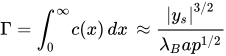
where is the reduced surface potential:


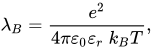
and is the Bjerrum length:

Layer-by-layer adsorption

Since charge plays a key role in polyelectrolyte adsorption, the initial rates of polyelectrolyte adsorption to charged surfaces are often rapid, limited only by the rate of mass-transport (diffusion) to the surface. This high rate then quickly drops off as charge accumulation at the surface occurs, and attractive forces are no longer drawing more polyelectrolyte chains to the surface. This drop in adsorption rates can be countered by exploiting the tendency for charge overcompensation to occur.[3] In the case of a negatively charged solid surface, cationic polyelectrolate chains are adsorbed to the oppositely charged surface. Their large size and high charge densities tend to overcompensate the original negative surface charge, resulting in a net positive charge due to the cationic polyelectrolytes. This solid surface, with its cationic polyelectrolyte film and consequent positive surface charge, can then be exposed to an anionic polyelectrolyte solution, where the process begins again, creating another film with an oppositely charged surface. This process can then be repeated to create several bilayers on the solid surface.


