Pomaderris pallida
From Wikipedia, the free encyclopedia
| Pomaderris pallida | |
|---|---|
 | |
| In Pine Island Reserve | |
Scientific classification  | |
| Kingdom: | Plantae |
| Clade: | Tracheophytes |
| Clade: | Angiosperms |
| Clade: | Eudicots |
| Clade: | Rosids |
| Order: | Rosales |
| Family: | Rhamnaceae |
| Genus: | Pomaderris |
| Species: | P. pallida |
| Binomial name | |
| Pomaderris pallida | |
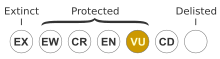
Pomaderris pallida, commonly known as pale pomaderris,[2] is a species of flowering plant in the family Rhamnaceae and is endemic to the south-east of continental Australia. It is a compact, rounded shrub with hairy stems, narrowly elliptic to narrowly oblong leaves and panicles of cream-coloured flowers.
Pomaderris pallida is a compact, rounded shrub that typically grows to a height of 1–2 m (3 ft 3 in – 6 ft 7 in), its stems covered with small woolly, whitish, star-shaped hairs. The leaves are narrowly elliptic to narrowly oblong, 8–20 mm (0.31–0.79 in) long and 3–6 mm (0.12–0.24 in) wide, both surfaces densely covered with velvety, star-shaped hairs. The flowers are borne in small, leafy panicles 20–80 mm (0.79–3.15 in) long with five cream-coloured, petal-like sepals but there are no petals. Flowering occurs from September to December and the fruit is a hairy capsule.[2][3][4]
Taxonomy
Pomaderris pallida was first formally described in 1951 by Norman Arthur Wakefield in The Victorian Naturalist from specimens collected by Richard Hind Cambage near the junction of the Murrumbidgee and Cotter Rivers in 1911.[5][6] The specific epithet (pallida) means "pale".[7]