Pomaderris parrisiae
From Wikipedia, the free encyclopedia
| Pomaderris parrisiae | |
|---|---|
 | |
| Near Jingera | |
Scientific classification  | |
| Kingdom: | Plantae |
| Clade: | Tracheophytes |
| Clade: | Angiosperms |
| Clade: | Eudicots |
| Clade: | Rosids |
| Order: | Rosales |
| Family: | Rhamnaceae |
| Genus: | Pomaderris |
| Species: | P. parrisiae |
| Binomial name | |
| Pomaderris parrisiae | |
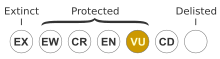
Pomaderris parrisiae is a species of flowering plant in the family Rhamnaceae and is endemic to southern New South Wales. It is a shrub to small, slender tree with silvery-hairy branchlets, elliptic to lance-shaped leaves and panicles of hairy, creamy-yellow flowers.
Pomaderris parrisiae is a shrub to slender tree that typically grows to a height of up to 9 m (30 ft), its branchlets and petioles covered with short, silvery hairs. The leaves are elliptic to lance-shaped, mostly 40–80 mm (1.6–3.1 in) long and 10–25 mm (0.39–0.98 in) wide with lance-shaped stipules about 5 mm (0.20 in) long at the base, but that fall off as the leaf develops. The upper surface of the leaves is glabrous and the lower surface is covered with silvery star-shaped hairs. The flowers are borne in pyramid-shaped panicles 30–80 mm (1.2–3.1 in) wide, each flower on a pedicel about 5 mm (0.20 in) long. The sepals are oblong, 2.5–3 mm (0.098–0.118 in) long, creamy-yellow and covered with star-shaped hairs on the back. The petals are egg-shaped with wavy edges, pale yellow and slightly shorter than the sepals. Flowering occurs in October and November and the fruit is a hairy capsule.[2][3][4]
Taxonomy
Pomaderris parrisiae was first formally described in 1990 by Neville Grant Walsh in the journal Muelleria from specimens collected in 1987.[2][5] The specific epithet (parrisiae) honours Margaret Parris of Merimbula, who collected the type specimens.[2]