Pomaderris sericea
From Wikipedia, the free encyclopedia
| Pomaderris sericea | |
|---|---|
Scientific classification  | |
| Kingdom: | Plantae |
| Clade: | Tracheophytes |
| Clade: | Angiosperms |
| Clade: | Eudicots |
| Clade: | Rosids |
| Order: | Rosales |
| Family: | Rhamnaceae |
| Genus: | Pomaderris |
| Species: | P. sericea |
| Binomial name | |
| Pomaderris sericea | |
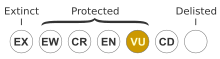
Pomaderris sericea, commonly known as bent pomaderris[2] or silky pomaderris,[3] is a species of flowering plant in the family Rhamnaceae and is endemic to south-eastern continental Australia. It is a shrub with silky-hairy new growth, narrowly elliptic leaves and panicles of yellow flowers. It is only known from three small populations and has not been seen since 1997.
Pomaderris sericea is a shrub that typically grows to a height of up to 2 m (6 ft 7 in), its new growth covered with silky, golden-brown hairs. The leaves are narrowly elliptic, 6–30 mm (0.24–1.18 in) long and 4–10 mm (0.16–0.39 in) wide, the upper surface of the leaves more or less glabrous, the lower surface covered with silky, golden-brown hairs. The flowers are yellow, borne in pyramid-shaped panicles 10–30 mm (0.39–1.18 in) long and wide, the floral cup, and sepals covered with whitish simple and star-shaped hairs. Flowering has been recorded in October and the fruit is a hairy capsule.[2][3][4]
Taxonomy
Pomaderris sericea was first formally described in 1951 by Norman Arthur Wakefield in The Victorian Naturalist from specimens he collected near the upper Genoa River Victoria in 1949.[5][6] The specific epithet (sericea) means "silky".[7]