Pomaderris subplicata
From Wikipedia, the free encyclopedia
| Pomaderris subplicata | |
|---|---|
Scientific classification  | |
| Kingdom: | Plantae |
| Clade: | Tracheophytes |
| Clade: | Angiosperms |
| Clade: | Eudicots |
| Clade: | Rosids |
| Order: | Rosales |
| Family: | Rhamnaceae |
| Genus: | Pomaderris |
| Species: | P. subplicata |
| Binomial name | |
| Pomaderris subplicata | |
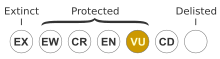
Pomaderris subplicata, commonly known as concave pomaderris,[2] is a species of flowering plant in the family Rhamnaceae and is endemic to Victoria in Australia. It is a shrub with softly-hairy branchlets, egg-shaped leaves, sometimes with the narrower end towards the base, and small clusters of pale yellow flowers.
Pomaderris subplicata is a shrub that typically grows to a height of 1–2 m (3 ft 3 in – 6 ft 7 in), its branchlets covered with soft, star-shaped hairs. The leaves are egg-shaped, sometimes with the narrower end towards the base, 3–10 mm (0.12–0.39 in) long and 3–6 mm (0.12–0.24 in) wide and often V-shaped in cross-section. Both surfaces of the leaves are covered with soft, star-shaped hairs. There are stipules 1–2 mm (0.039–0.079 in) long at the base of the leaves, but that fall off as the leaf matures. The flowers are borne in small clusters in leaf axils near the ends of branchlets, each flower pale yellow on a pedicel 1.0–2.5 mm (0.039–0.098 in). The sepals are 1.5–1.8 mm (0.059–0.071 in) long, and fall off as the flower matures and the petals are 0.5–1.0 mm (0.020–0.039 in) long but fall off as the flowers open. Flowering occurs in October.[3][4]
Taxonomy
Pomaderris subplicata was first formally described in 1992 by Neville Grant Walsh in the journal Muelleria from specimens Walsh collected near Carboor Upper in north-east Victoria in 1990.[3][5] The specific epithet (subplicata) means "somewhat folded", referring to the leaves.[3]