Pranala
From Wikipedia, the free encyclopedia


In Hindu temple architecture, a pranala (IAST: praṇāla) is a discharge outlet attached to the wall of the sanctum. It discharges the lustral water or other liquids poured over the idols.
The earliest evidence of the pranalas can be dated to the Shaka-Kushana period in northern India. The pranalas continued to be used in the subsequent years, including the Gupta period. However, the elaborately sculptured pranalas first appear only in the 8th century CE. The pranalas were common in several parts of India; they were less common in the Hindu architecture of Southeast Asia, except in Java.[1]
The pranala is also known as praṇāli, nāla, nāli,[2] gomukha, or nirgama.[3] Some 20th century French archaeologists have used the term "soma-sūtra" to describe the pranala, but Indian texts clearly distinguish between these two terms: a soma-sūtra is a line along which the pranala is placed.[4]
Designs
Pranalas are used to drain out the abhisheka-teertham water, milk, ghee, etc. poured over the temple idols.[5]
The most common type of pranala in historical temples is the makara-pranala, which is similar to the European gargoyle. It depicts the mythical sea-creature makara (also called graha).[1] The popularity of the makara-pranala probably results from the creature's association with water.[6] The 11th century text Samarangana Sutradhara recommends making a pranali (that is, pranala) drain all around the sanctum, with an outlet in the shape of a graha (or makara). Vishvakarma's Vastushastra, a late 11th century compendium on the Māru-Gurjara architecture, also mentions the pranala.[1] Aparajita-prchchha, dated late 12th to early 13th century, refers to the makara-pranala used to clear the water out of the temple's jagati (platform).[7]
The next most common type of pranala is the grasa-pranala, which depicts the grasa (also known as kirtimukha) mythical creature. The gorgon of the early Greek temples inspired the Indian grasa-pranala, which in turn, inspired the similar motifs in South-East Asia, particularly Java.[8] The grasa-pranala is common in the historical temples of south India;[9] a few examples have also been discovered in Madhya Pradesh, in central India.[10]
The simha-pranala, which depicts a lion, is similar to the grasa-pranala.[10] It is probably inspired by the lion-head spouts that were common in Classical Greek, Hellenistic, and Roman temples.[8] A variation of this form is the simha-nala, which features a tube coming out of a lion's mouth: the tip of the tube may depict another lion's mouth (this type is called simha-mukha-nala), or another object, such as a lotus bud.[11]
Other forms include:
- Bhuta-pranala: depicts a bhuta or jambhaka, a goblin-like creature.[8]
- Ghata-pranala: depicts a ghata or spherical plot, often held by a human figure.[12]
- Marala-pali: depicts the peripheral wall of a house (marala) and a pot (pali) stationed for collecting the drainage water.[13]
- Snapana-griha or Chandesha-griha: A special shrine for a Chandesha (IAST: Caṇḍeśa, a deity); the water from the temple's sanctum is received into this shrine.[14]
- Undecorated nala: These are inornate water spouts; common in temples of Tamil Nadu (especially those from the Chola period).[15]
Pranalas with unique designs also exist: for example, the Koteshwara Temple in Srikakulam has a pranala in which the water spouts out of the bust of a Nandi figure.[16]

 Makara-pranala at Borobudur, Indonesia
 A makara-pranala at the Hazara Rama temple
 A simple pranala at a temple in Tamil Nadu
 A pranala at Banda Deul temple in West Bengal
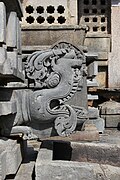 Makara-pranala at Lakshmi Devi Temple
 Pranala at Someshwar temple in Bhangarh Fort
 Pranala at a Hindu temple in Johor Bahru, Malaysia


_-_img_37.jpg)
Examples
Some notable examples of the pranala are:
| Type | Location | Date | Style | Source |
|---|---|---|---|---|
| makara-matsya (fish) | IN-UP: Kankali Tila (now at Mathura Museum) | c. 1st century BCE-2nd century CE | probably Satraps of Mathura | [17] |
| makara-matsya | IN-UP: Mathura Museum | c. 1st century-2nd century | probably Kushana | [17] |
| makara | IN-UP: Rajghat, Varanasi | c. 1st century-2nd century | Satraps-Kushana or Tribal | [17] |
| simha-mukha (two pieces) | LK-7: Anuradhapura: Thuparamaya | c. 2nd-3rd century | ? | [18] |
| grasa | IN-MH: Brick temple, Gondia | c. 5th century | Vakataka | [8] |
| grasa | IN-MP: Tigawa | c. 5th century | Gupta | [19] |
| grasa | IN-MP: Bhumara Temple | c. 5th century | Gupta | [19] |
| grasa | IN-MP: Mahdia temple | c. 5th century | Gupta | [19] |
| makara | IN-RJ: Gupta temple, Nagari | c. mid-5th century | Gupta | [20] |
| makara | IN-MP: Gupta temple, Deogarh | c. late 5th century | Gupta | [20] |
| makara pranalas (two pieces) | IN-UP: Sarnath Museum | c. 5th-6th century | Late Gupta | [21] |
| grasa / matanga-makara | IN-MP: Shiva temple, Tala | c. 6th century | Post-Vakataka | [22] |
| bhuta | IN-TN: Dharmaraja Ratha, Mahabalipuram | c. 640 | Tondainadu (Pallava) | [23] |
| kapi (monkey) | IN-TN: Dharma-raja ratha, Mahabalipuram | c. 640 | Tondainadu (Pallava) | [23] |
| kalamakara (vyala-makara hybrid) | VN-27: Trà Kiệu, Vietnam | c. mid-7th century | Champa | [24] |
| makara | IN-KA: Lakulisha temple, Siddanakolla | c. 700 | Early Karnata (Chalukya) | [25] |
| makara | IN-TG: Sangameshvara temple, Kudaveli | c. early 8th century | Karnata-Nagara: Andhra school (early Chalukya) | [26] |
| grasa | IN-KA:Galaganatha Temple, Pattadakal | c. early 8th century | Karnata-Nagara: Alampur school (early Chalukya) | [10] |
| grasa | IN-KA:Virupaksha (Lokeshvara) Temple, Pattadakal | c. 725-733 | Early Chalukya | [10] |
| grasa | IN-KA:Sangameshwara Temple, Pattadakal | c. 740 | Early Chalukya | [10] |
| matanga-nakra | IN-MP: Teli ka Mandir | c. mid-8th century | Early Gopadri | [19] |
| damaged | IN-MH: Kailasha temple, Ellora | c. 756-776 | Early Karnata (Rashtrakuta) | [27] |
| makara | LK-7: Anuradhapura Museum | c. 8th century or earlier | [28] | |
| makara | LK-7: Anuradhapura (Isurumuniya) | c. 8th century | [29] | |
| makara (graha) | ID-JT: Borobudur, Indonesia | c. 8th century | Javanese | [30] |
| ghata held by Nagaraja | IN-AP: Madhukeshwara Temple, Mukhalingam | c. 8th century (last quarter) | Early Kalinga (Bhauma-Kara) | [12] |
| ghata held by two vidyadharis | IN-RJ: Harshat mata temple, Abhaneri (now at Amber Museum) | c. late 8th century | Sapadalaksha (probably early Chahamana) | [13] |
| grasa | ID-JT: Borobudur, Indonesia | c. 800 | Javanese | [31] |
| bhuta | IN-TN: Kaveripakkam | c. 800 | Late Tondainadu (Late Pallava) | [32] |
| makara | KH-13: Prasat Krahom, Cambodia | c. 825-875 | Cambodian | [24] |
| makara | IN-RJ: Vishnu temple, Kusuma | c. mid-9th century | Maha-Gurjara | [9] |
| simha | IN-AP: Nakkala gudi temple at Biccavolu | c. 9th century | Andhra Style (Eastern Chalukya) | [33] |
| bhuta | IN-TN: Jalanatheeswarar Temple, Thakkolam | c. 875 | Late Tondainadu (Late Pallava) | [32] |
| simha-nala | IN-TN: Apatsahayesvarar Temple | c. 884 | Cholanadu (early Chola) | [34] |
| makara | VN-27: Mỹ Sơn, Vietnam | c. 9th or 10th century | Champa | [24] |
| grasa | IN-KA: Akka-Tangai temple, Manne | c. early 10th century | Early Karnata (Rashtrakuta) | [10] |
| grasa | IN-KA: Kalleshvara Temple, Bagali | c. early 10th century | Late Karnata (Chalukya) | [10] |
| snapana-griha | IN-GJ: Trinetreshvara temple, Tarnetar | c. 10th century (2nd quarter) | Maha-Gurjara (Chapa) | [14] |
| makara | IN-KA: Lakshmaneshvara temple, Avani | c. 934 | Nolambavadi (Nolamba) | [25] |
| simsumara (a sea-creature) | IN-AP: Bhimeshvara temple at Bhimavaram | c. 10th century | Andhra Style (Eastern Chalukya) | [35] |
| ghata held by a vidyadhara | IN-MP: Lakshmana Temple, Khajuraho | c. 954 | Jejakabukti (Chandella) | [36] |
| bhuta | IN-MP: Lakshmana Temple, Khajuraho | c. 954 | Jejakabukti (Chandella) | [32] |
| makara | KH-17: Pre Rup, Cambodia | c. 947-965 | Cambodian | [24] |
| snapana-griha | IN-RJ: Ambika Mata Temple, Jagat, Rajasthan | c. 961 | Maha-Gurjara (Guhila) | [37] |
| simha-nala | IN-TN: Tirunarayur Siddhanatheswarar Temple | 986 | Cholanadu (Middle Chola) | [34] |
| makara | IN-KA: Nandappa temple, Sirwal | c. 10th century (last quarter) | Later Karnata (Chalukya) | [25] |
| nala | IN-TN: Enadi Siva Temple | c. late 10th century | Pandinadu (Chola-Pandya) | [34] |
| nala | IN-TN: Kandalishvara temple, Tenneri | c. 995 or earlier | Cholanadu (Later Chola) | [38] |
| kari-makara, a hybrid of an elephant and a makara | IN-BR: Indian Museum, Kolkata, found in Bihar | c. 10th-11th century | Early Magadha (late Pala) | [39] |
| ghata held by a vidyadhari | IN-MP: Gurgi (Gurh); now at Ahmedabad Municipal Museum | c. 10th-11th century | Dahala (Chedi) | [36] |
| marala-pali / ghata held by a human figure, possibly Chandesha | IN-RJ: Nagada | c. 1000 | Maha-Gurjara | [37] |
| nala, with a lion figure at the bottom | IN-TN: Ganapati shrine, Sakalabuvaneswarar Temple complex, Tirumeeyachur | c. early 11th century | Cholanadu (Middle Chola) | [40] |
| simha-mukha with floral ending | IN-TN: Ganapati shrine, Muyarchinatheswarar Temple complex | c. early 11th century | Cholanadu (Middle Chola) | [41] |
| simha-mukha | IN-TN: Kailasanathar temple, Brahmadesam | c. early 11th century | Pandinadu (Chola-Pandya) | [42] |
| ghata held by a human figure | IN-GJ: Shiva temple, Kevan (near Shravana, Sabarkantha) | c. early 11th century | Maru-Gurjara (Chaulukya) | [37] |
| vyala | IN-KL: Vadakkunnathan Temple, Thrissur (main temple and Rama shrine) | c. early 11th century | Middle Kerala | [21] |
| makara | IN-KA: Jain Temple, Lakkundi | 1008 | Later Karnata (Chalukya) | [25] |
| bhuta | IN-TN: Brihadisvara Temple, Thanjavur | 1010 | Chola | [43] |
| nala with makara | IN-KA: Galageshvara temple, Galaganatha | c. 1025 | Later Karnata (Chalukya) | [21] |
| makara | IN-GJ: Mahavira marble temple, Kumbharia | c. 1062 | Maru-Gurjara style | [7] |
| ? | IN-MP: Udayeshvara temple, Udaipur, Madhya Pradesh | c. 1080 | Malava (Paramara) | [44] |
| simha-nala | IN-TN: Varadaraja Perumal Temple complex - Amman shrine | c. 11th century | Cholanadu (Middle Chola) | [45] |
| simha-nala | IN-TN: Varadaraja Perumal Temple complex - Shrine No. 1 | c. 11th century | Cholanadu (Middle Chola) | [45] |
| vyala | IN-KL: Rama temple, Triprayar | c. 11th century CE | Middle Kerala | [21] |
| makara | IN-RJ: Chandravati temple | c. 11th century | Maru-Gurjara style | [7] |
| makara | IN-MP: Bhojeshwar Temple, Bhojpur | 11th century | [7] | |
| makara | IN-MP: Bijamandala mosque, Vidisha | c. 11th century | Malava (Paramara) style | [7] |
| makara | IN-MP: Adinatha temple, Khajuraho | c. 11th century (3rd quarter) | Jejakabukti (Chandella) | [46] |
| ghata held by a vidyadhara or Chandesha | IN-MP: Indore Museum | c. late 11th century | Malava (Paramara-Guhila) | [13] |
| kari-makara | IN-BR: Munger, now at Patna Museum | c. 11th-12th century | Late Magadha style, possibly from the Sena period | [47] |
| simha-nala, with bhuta supporting the pranala from below | IN-TN: Amirthakadeswarar Temple, Melakadambur | c. 1110-1113 | Cholanadu (Chola, Late phase) | [48] |
| makara | IN-KA: Lakshmi Devi Temple, Doddagaddavalli | 1112 | Later Karnata (Hoysala) | [28] |
| makara | IN-KA: Chennakeshvara Temple, Marale | 1130 | Later Karnata (Hoysala) | [28] |
| simha-mukha | IN-TN: Airavatesvara Temple | 1146-1172 | Cholanadu (Late Chola) | [49] |
| simha | IN-TN: Airavatesvara Temple complex - Daivanayaki-Amman shrine | 1146-1172 | Cholanadu (Late Chola) | [49] |
| nala | LK-7: Shiva Devale No. 1, Polonnaruwa | c. 12th century | Later Cholanadu (Later Chola) | [50] |
| makara, with a bhuta below, and a goddess above | IN-AP: Bhavannarayana temple, Sarpavaram | c. 12th century | Later Andhra (Eastern Chalukya) | [51] |
| simsumara (a sea-creature) | IN-AP: Mandavya-Narayana temple at Samalkota | c. 12th century | Late Vengi (Eastern Chalukya) | [52] |
| makara | IN-GJ: Jina Ajitanatha, Taranga | c. 1165 | Maru-Gurjara style | [7] |
| matanga-makara (elephant-makara) | IN-AP: Varaha Lakshmi Narasimha temple, Simhachalam | c. 1238-1268 | Andhra-Kalinga style (Ganga) | [52] |
| makara | IN-MH: Gondeshwar Temple, Sinnar | c. 13th century | Seuna-desha style | [7] |
| makara | IN-MP: Bhoramdeo Temple, Madhya Pradesh | c. 13th century | Dahala-Andhra (Chedi-Kakatiya) style | [46] |
| nakra (crocodile) | IN-OR: Chayadevi temple within the Konark Sun Temple complex | c. 13th century | Later Kalinga (Ganga) | [53] |
| matanga-makara or saunda-makara (elephant-makara hybrid) | IN-OR: Chayadevi temple within the Konark Sun Temple complex | c. 13th century | Later Kalinga (Ganga) | [53] |
| nandi | IN-AP: Koteshwara Temple, Srikakulam | c. 15th century | Vijayanagara | [16] |
| nala | IN-TN: Vaishnava temple, Srimushnam | c. 15th century | Nayaka | [48] |
| nala with vyala leaping from lion's mouth | IN-TN: Amman shrine, Ambika temple complex, Kalakadu | c. late 15th century | Nayaka | [16] |
| simha-nala | IN-TN: Avudaiyarkoil temple | c. late 15th or early 16th century | Madurai Nayaka | [16] |
| simha-nala | IN-TN: Sattainathar Temple, Sirkazhi | c. 15th-16th century | Thanjavur Nayaka | [54] |
| nala with vyala leaping from lion's mouth | IN-TN: Bhaktavatsala temple, Cheranmahadevi | c. early 16th century | Nayaka | [16] |
| nala with floral petals | IN-KA:Rameshvara temple, Keladi | c. early 16th century | Keladi-Nayaka | [55] |
| nala with floral petals | IN-KA:Virabhadra temple, Keladi | c. early 16th century | Keladi-Nayaka | [55] |
| nala with lion head at orifice, and lotus bud at the tip | IN-KA: Vitthala temple, Hampi | c. 16th century (first half) | Vijayanagara | [49] |
| simha-nala | IN-KA: Aghoreshvara temple, Ikkeri | c. 1515-1545 | Ikkeri-Nayaka | [55] |
| nala | IN-KA: Amman shrine, Vitthala temple complex, Hampi | c. 16th century | Vijayanagara | [21] |
| simha-nala | IN-TN: Chandramouleeswar temple, Thiruvakkarai | c. 16th century | Thanjavur Nayaka | [55] |
| simha-nala | IN-TN: Vedagiriswarar temple | c. late 16th century | Thanjavur Nayaka | [54] |
| simha-nala | IN-TN: Kumbeswarar Temple, Kumbakonam | c. 16th-17th century | Thanjavur Nayaka | [54] |
| simha-nala | IN-TN: Swaminathaswamy temple, Swamimalai | c. 16th-17th century | Thanjavur Nayaka | [54] |
| nala | IN-TN: Raghaveshvara temple, Darasaguppe | c. 16th-17th century | Nayaka | [21] |
| nala | IN-TN: Subrahmanya shrine, Brihadishvara temple complex, Thanjavur | c. 17th century | Nayaka | [21] |
References
- 1 2 3 M. A. Dhaky 1982, p. 121.
- ↑ M. A. Dhaky 1982, p. 119.
- ↑ S. K. R. Rao 2001, p. 103.
- ↑ M. A. Dhaky 1982, pp. 147–148.
- ↑ S. P. Gupta & S. N. Vijayakumar 2010, p. 204.
- ↑ M. A. Dhaky 1982, p. 134.
- 1 2 3 4 5 6 7 M. A. Dhaky 1982, p. 122.
- 1 2 3 4 M. A. Dhaky 1982, p. 141.
- 1 2 M. A. Dhaky 1982, p. 138.
- 1 2 3 4 5 6 7 M. A. Dhaky 1982, p. 139.
- ↑ M. A. Dhaky 1982, pp. 147–149.
- 1 2 M. A. Dhaky 1982, p. 143.
- 1 2 3 M. A. Dhaky 1982, p. 144.
- 1 2 M. A. Dhaky 1982, p. 145.
- ↑ M. A. Dhaky 1982, pp. 151–52.
- 1 2 3 4 5 M. A. Dhaky 1982, p. 157.
- 1 2 3 M. A. Dhaky 1982, pp. 132–135.
- ↑ M. A. Dhaky 1982, pp. 139–140.
- 1 2 3 4 M. A. Dhaky 1982, p. 137.
- 1 2 M. A. Dhaky 1982, p. 136.
- 1 2 3 4 5 6 7 M. A. Dhaky 1982, p. Appendix.
- ↑ M. A. Dhaky 1982, pp. 137–138.
- 1 2 M. A. Dhaky 1982, pp. 141–142.
- 1 2 3 4 M. A. Dhaky 1982, p. 132.
- 1 2 3 4 M. A. Dhaky 1982, p. 129.
- ↑ M. A. Dhaky 1982, pp. 128–129.
- ↑ M. A. Dhaky 1982, p. 161.
- 1 2 3 M. A. Dhaky 1982, p. 130.
- ↑ M. A. Dhaky 1982, pp. 130–132.
- ↑ M. A. Dhaky 1982, pp. 131–132.
- ↑ M. A. Dhaky 1982, pp. 140–141.
- 1 2 3 M. A. Dhaky 1982, p. 142.
- ↑ M. A. Dhaky 1982, p. 127, 139.
- 1 2 3 M. A. Dhaky 1982, p. 148.
- ↑ M. A. Dhaky 1982, pp. 126–127.
- 1 2 M. A. Dhaky 1982, pp. 143–144.
- 1 2 3 M. A. Dhaky 1982, pp. 143–145.
- ↑ M. A. Dhaky 1982, p. 151.
- ↑ M. A. Dhaky 1982, pp. 124–125.
- ↑ M. A. Dhaky 1982, pp. 149, 152.
- ↑ M. A. Dhaky 1982, p. 149, 153.
- ↑ M. A. Dhaky 1982, p. 149.
- ↑ M. A. Dhaky 1982, pp. 152–153.
- ↑ M. A. Dhaky 1982, pp. 161–162.
- 1 2 M. A. Dhaky 1982, p. 154.
- 1 2 M. A. Dhaky 1982, p. 123.
- ↑ M. A. Dhaky 1982, pp. 125–126.
- 1 2 M. A. Dhaky 1982, p. 150.
- 1 2 3 M. A. Dhaky 1982, pp. 153–154.
- ↑ M. A. Dhaky 1982, p. 152.
- ↑ M. A. Dhaky 1982, p. 153.
- 1 2 M. A. Dhaky 1982, p. 126.
- 1 2 M. A. Dhaky 1982, p. 124.
- 1 2 3 4 M. A. Dhaky 1982, p. 155.
- 1 2 3 4 M. A. Dhaky 1982, p. 156.
Bibliography

- M. A. Dhaky (1982). "The "Praṇāla" in Indian, South-Asian and South-East Asian Sacred Architecture". In Bettina Bäumer (ed.). Rupa Pratirupa: Alice Boner commemoration volume. New Delhi: Biblia Impex. OCLC 10541431.
- S. K. R. Rao (2001). Vāstu-Śilpa-Kosha. Vol. 1. Kalpatharu. ISBN 978-93-81218-51-8.
- S. P. Gupta; S. N. Vijayakumar (2010). Temples in India: Origin and Developmental Stages. Delhi: Centre for Research and Training in History, Archaeology and Paleo-Environment / DK Printworld. ISBN 978-81-246-0496-0.