Prasophyllum morganii
From Wikipedia, the free encyclopedia
| Cobungra leek orchid | |
|---|---|
 | |
| Illustration by Nicholls from The Victorian Naturalist[1] | |
Scientific classification  | |
| Kingdom: | Plantae |
| Clade: | Tracheophytes |
| Clade: | Angiosperms |
| Clade: | Monocots |
| Order: | Asparagales |
| Family: | Orchidaceae |
| Subfamily: | Orchidoideae |
| Tribe: | Diurideae |
| Subtribe: | Prasophyllinae |
| Genus: | Prasophyllum |
| Species: | P. morganii |
| Binomial name | |
| Prasophyllum morganii | |
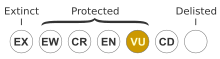
Prasophyllum morganii, commonly known as the Cobungra leek orchid, is a species of orchid endemic to a small area in Victoria. It has a single tubular leaf and up to eighty greenish flowers with purplish markings. Before being rediscovered in 2020, the plant had last been seen in 1933 and was presumed extinct.
Prasophyllum morganii is a terrestrial, perennial, deciduous, herb with an underground tuber and a single tube-shaped leaf up to 160 mm (6 in) long and 4–10 mm (0.2–0.4 in) wide. Between fifty and eighty scented, widely-opening flowers are crowded along flowering stem 40–100 mm (2–4 in) long which reaches to a height of 100–250 mm (4–10 in). The flowers are greenish with purple markings and as with others in the genus, are inverted so that the labellum is above the column rather than below it. The ovary is oval-shaped and 3–4 mm (0.1–0.2 in) long. The dorsal sepal is broadly egg-shaped, green and 4–5 mm (0.16–0.20 in) long and the lateral sepals are a similar length but narrower and are free from each other. The petals are similar in size to the lateral sepals and curve forwards. The labellum is heart-shaped, purplish or pink, up to 4 mm (0.2 in) long and turns upwards. There is a deep purplish, triangular callus with a V-shaped ridge along the centre of the labellum. Flowering occurs in October and November.[3][4]
Taxonomy and naming
Prasophyllum morganii was first formally described in 1930 by William Henry Nicholls and the description was published in The Victorian Naturalist from a specimen collected near Cobungra.[2][5]